Hard truths on best coffee makers under $100 for daily use
I’ve spent the last few weeks looking at coffee makers. Not because I’m a “coffee snob” who needs a machine that costs more than my rent, but because I’m tired of waking up, pressing a button, and getting nothing but a sad, lukewarm puddle.
If you have $100, you have enough to get a machine that makes decent coffee for years. But you also have enough to buy absolute garbage that will end up in a landfill by next summer. I look at coffee makers the way I look at my tax software—I want the thing that does the job without any hidden fees or unexpected crashes.
Most lists online are written by people who get paid to tell you that every new shiny plastic thing is a miracle. I don’t do that. I go to the one-star reviews. I look for the people who bought the machine, used it for six months, and had it leak all over their counter. That’s how you find the actual best coffee makers under $100 for everyday use.
The Problem with “Cheap” Coffee Makers
The biggest trap in the kitchen gear world is the “budget” machine that tries to do everything. If you see a coffee maker for $40 that claims to be a grinder, a brewer, and a milk frother, run. It’s physically impossible for those components to be high quality at that price point.
When a machine is too cheap, the manufacturer cuts corners on the heating element and the pump. As explained in basic coffee extraction science, your water needs to hit the grounds at a specific temperature—usually between 196°F and 201°F—to get a good flavor. If your cheap machine hits the water at 170°F, you get sour coffee. If it gets too hot, you get bitter, burnt sludge.
Most people don’t know that coffee is a science, but you don’t need a lab coat to get it right. You just need a machine that doesn’t lie about its water temperature.
How I Pick My Gear (The “Accounting Brain”)
I don’t care if a machine is “sleek” or “modern.” I care if it’s repairable and if the parts are food-safe. When you’re dealing with plastic reservoirs and internal tubing, you want to make sure you aren’t leaching anything into your morning cup. I always check the FDA’s guidance on food-contact materials before I let a piece of plastic get anywhere near my boiling water.
When I look at a coffee maker, I’m looking for:
- Ease of cleaning: If I can’t reach inside to scrub the scale, it’s a no-go.
- Replacement parts: Can I buy a new carafe if I break this one, or do I have to toss the whole machine?
- Simplicity: Fewer buttons mean fewer things that can break while I’m still half-asleep.
The Simple Drip Coffee Maker: The Reliable Workhorse
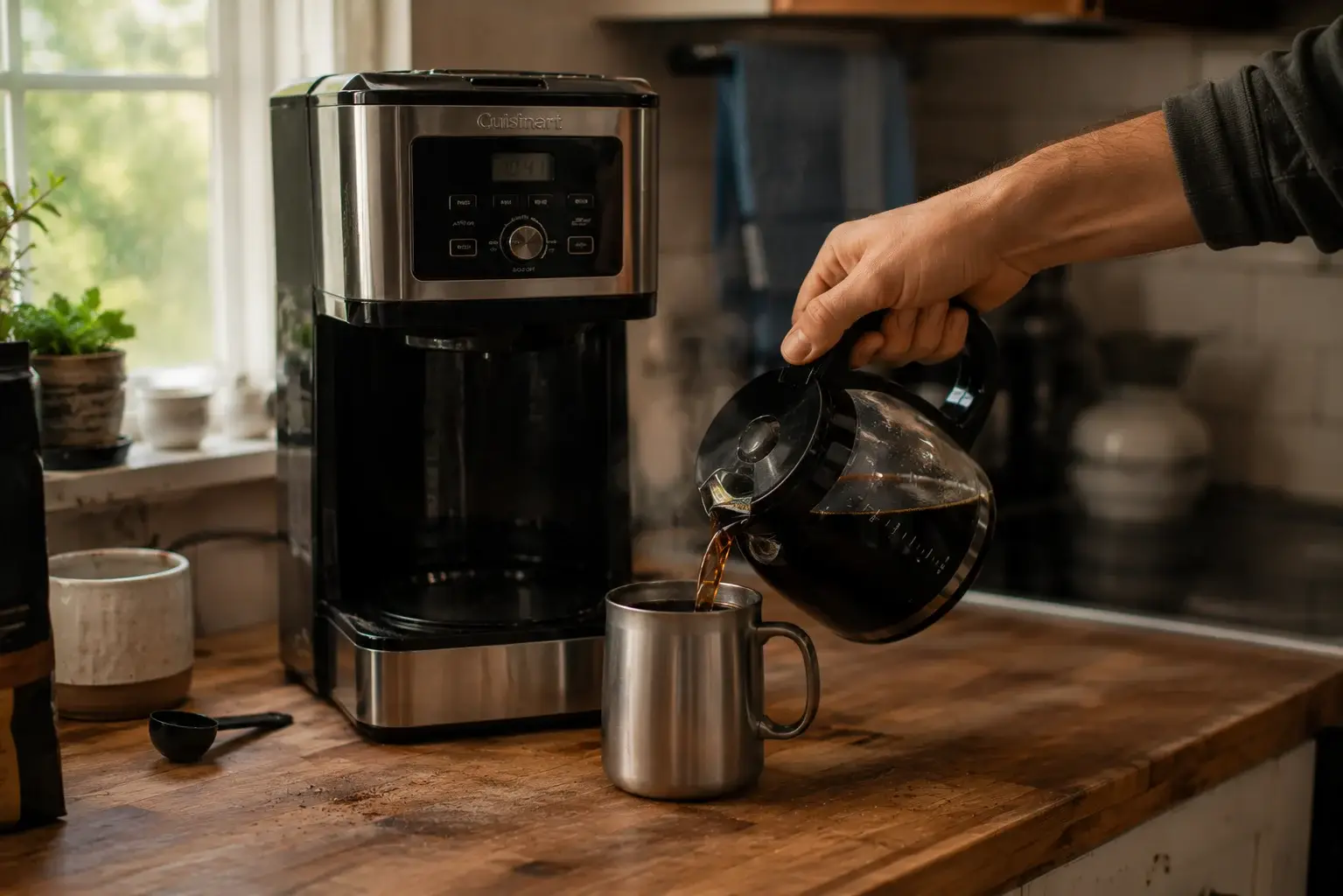
For 90% of people, a basic drip machine is the only thing you need. It’s not fancy, but it’s the most reliable way to make a big pot of coffee for the week.
The OXO Brew 8-Cup Coffee Maker
This is the one I keep coming back to. It’s right at the edge of the $100 mark, but it actually holds a consistent temperature. Most cheap drip machines have a “hot plate” that keeps the coffee sitting there, slowly turning into burnt oil. This one focuses on the brew process first.
If you’re a beginner, don’t worry about “programming” a machine to start at 5 AM. Just learn to set your machine up the night before. You want a machine with a simple basket that’s easy to rinse out. You can read more about how standard food-safe equipment should be tested to ensure it isn’t leaking chemicals into your water.
The Manual Approach: French Press
If you have $20, you can get a French Press that will outlast any $100 electric machine. There are no wires to fray, no heating elements to burn out, and no pumps to clog. It’s just glass and metal.
The only downside is you have to boil your own water. I use a simple stainless steel kettle. It takes about three minutes. The flavor is richer because it doesn’t use a paper filter to strip out all the oils. It’s a bit messy to clean, but that’s the trade-off.
Why I Always Read the One-Star Reviews
When I was looking at a popular “budget” brand last month, the front page of Amazon looked great. Everyone was posting pictures of their beautiful, aesthetic coffee stations. But when I sorted by “Most Recent” and “One Star,” I saw a pattern: “Stopped heating after 4 months.”
That’s the data point that matters. I’d rather have a machine that looks like it belongs in a dorm room but works for five years, rather than a machine that looks like a spaceship but breaks the moment the warranty expires.
According to testing methodology tips from Consumer Reports, the longevity of these machines is often tied to how well they handle mineral buildup. If you live in an area with “hard” water, your machine will die twice as fast unless you descale it.
The Maintenance Truth: Keep it Clean
No matter which machine you pick, it will die if you don’t clean it. I’ve seen people throw away a perfectly good $80 machine because it was “broken,” when it was really just clogged with calcium.
Once a month, mix white vinegar and water. Run a cycle. Then run two more cycles with just water. That’s it. It’s not a “deep cleanse” or a “ritual.” It’s just keeping your tool in working order. The Penn State Extension has great resources on how food safety and cleanliness work in a kitchen environment, which is a good reminder that your coffee maker is just another food-prep tool.
FAQ
1. Is it actually worth buying a machine with a built-in grinder?
Usually, no. If you have a $100 budget, a machine that includes a grinder is cutting costs on both the brewing and the grinding. Buy a separate, decent burr grinder. Your coffee will taste better, and if the grinder breaks, you don’t have to throw away your coffee maker.
2. Why does my coffee taste like plastic?
If it’s a new machine, you need to run at least three cycles of plain water through it before you use it for coffee. If it’s an old machine, the plastic is likely degrading. That’s a sign it’s time to replace it.
3. Does “Gold Tone” filter really matter?
It changes the flavor by letting more oils into the cup. It’s less waste than paper filters, but it’s harder to clean. If you like a “clean” cup of coffee, stick with paper. If you like a bit of body, go for the metal mesh.
4. How long should a coffee maker last?
A well-maintained drip coffee maker under $100 should last you at least two to three years. If it lasts less than a year, it was a bad design, not bad luck.
5. Can I use tap water?
Most of the time, yes. But if your tap water tastes like chlorine, your coffee will taste like chlorine. A simple pitcher filter is enough to fix that.
6. Does the “keep warm” setting ruin the coffee?
Yes. If coffee stays on a hot plate for more than 20 minutes, it starts to oxidize and taste like cardboard. Brew what you’re going to drink, or pour it into a thermos right after it finishes.