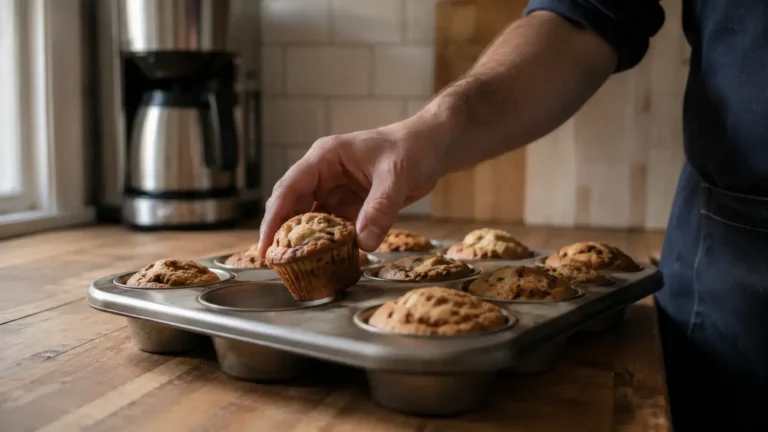
Why you need a cooling rack: The “soggy bottom” test
When I first started living on my own in my tiny apartment, my kitchen gear was a joke. I had one pot, one skillet, and a spatula that I am pretty sure was melting the first time I used it. I thought a “cooling rack” was something fancy people used to look like they were on a cooking show. My mom, Linda, used them, but she also made biscuits from scratch before I was even awake. I figured she just had “the touch” and that the gear didn’t matter.
Fast forward to me spending way too much time in a spreadsheet trying to figure out why my store-bought cookie mix always turned out soft and gummy on the bottom. I realized I was leaving them on the hot baking sheet to “cool.” That’s when I finally bought a basic wire rack.
Here is what I found out about why you need a cooling rack, and why it is actually about science, not status.
What is a cooling rack actually doing?
A cooling rack is just a grid of wires. It looks simple. But its job is to manage heat and moisture. When you take a batch of cookies or a loaf of bread out of the oven, the inside is still piping hot. That heat has to go somewhere.
If you leave your food on the hot metal pan, the bottom of the food stays hot. It also stays in contact with the moisture trapped between the bottom of the food and the pan. This is how you get a “soggy bottom.” The steam can’t go down because the pan is in the way. It stays in the food.
By lifting the food off the pan and onto a rack, you let air circulate underneath. According to the basic principles of thermodynamics as explained by Wikipedia, creating a path for this air to move allows heat to escape through the bottom as well as the top. This stops the steaming process. Your crust stays crisp instead of getting soft.
The “Accounting Brain” check: Is it just for cookies?
My accounting degree taught me to look for return on investment. If I buy a tool, does it do one thing or many? I don’t like gadgets that take up space and do nothing.
A cooling rack isn’t just for cookies. I use mine for:
- Draining fried foods: If you make bacon or anything in a fryer, laying it on a paper towel is okay, but the fat just sits there. A rack keeps the grease away from the food.
- Roasting vegetables: If you put your rack inside a baking sheet, you can roast chicken or veggies so they get crispy on the bottom, too.
- Glazing or frosting: If you have to put a glaze on a cake, putting it on a rack over a tray makes the mess easy to clean up.
When you look at the USDA guidelines for safe food handling, they emphasize keeping foods at safe temperatures. While a cooling rack isn’t a food safety tool, moving food out of the “danger zone” faster by cooling it evenly is just smart practice.
Does the brand matter?
I have looked at a lot of these. Some are cheap, thin, and bend if you put a heavy pan on them. Others are “heavy duty.”
I bought a cheap one once, and the coating started flaking off after a month. I do not want bits of mystery metal in my dinner. When I shop, I look for stainless steel. It is durable and easy to scrub. If you go for the non-stick ones, the FDA has pages on food-contact materials and safety, and while most are safe, cheaper coatings eventually fail. I prefer to just avoid the coating altogether.
Comparison Table: Cooling Rack Types
| Type | Best For | Pros | Cons |
| Simple Grid | Cookies, bread | Cheap, fits anywhere | Can be flimsy |
| Nested Rack | Sheet pan roasting | Keeps fat off food | Harder to wash |
| Adjustable | Large loaves | Fits many sizes | Too many parts |
I stick with a simple, heavy-gauge stainless steel rack. It fits in my dishwasher. It doesn’t rust. It does the job.
Why I hate bad reviews (and why I read them)
When I was shopping for my current rack, I saw one that had 4.8 stars. Everyone said it was “perfect.” Then I went to the one-star reviews. People said it arrived bent. Others said it rusted after one wash.
That told me the quality control was a mess. I ended up picking a mid-priced one that had a few reviews saying it was “heavy” or “boring.” To me, “boring” means it just works. I don’t need a cooling rack to be a life-changing event. I need it to hold up a tray of cookies without turning into a taco shape.
[YOUTUBE EMBED: “How to tell if your cookware is safe” — Ethan Chlebowski — This video explains how to look past marketing claims to see if a product is actually well-made.]
The “Soggy Bottom” test: My results
I took two trays of my mom’s chili-spiced biscuits. One tray stayed on the hot pan. The other went straight to the cooling rack.
After ten minutes, the tray on the pan was soft on the bottom. The ones on the rack were crisp. It wasn’t magic. It was just physics. My mom was right all along, but don’t tell her I said that.
FAQ
1. Can I just use a plate?
You can, but it is not ideal. A plate is solid. It doesn’t let air flow under the food. Your food will stay hot and steam itself. It is better than a hot pan, but a wire rack is much better.
2. Do I need to buy an expensive brand?
No. You need something that won’t rust and won’t bend. Look for “stainless steel” on the label. If it looks like it is made of cheap, thin wire, skip it.
3. Is my rack dishwasher safe?
Most stainless steel ones are. Always check the manual. If you have a non-stick one, I would hand wash it to keep the coating from peeling.
4. Can I use the rack inside the oven?
Only if it says it is “oven-safe.” Some are made for cooling only and the coating or the feet might melt if the temperature is too high. Check the box before you roast.
5. How do I clean stuck-on food?
If you let food sit on the rack, it gets tough. Soak it in warm, soapy water for ten minutes. Use a stiff brush. Do not use steel wool if you have a coated rack, or you will ruin the finish.
6. Why does my cooling rack smell like burnt metal?
If it smells like burnt metal, it is likely a cheap coating burning off in the heat. Stop using it in the oven. It is not worth the risk to your health.
7. Does the size of the grid matter?
Yes. If the grid is too wide, small cookies will fall through. Look for a “tight grid” pattern if you bake small things like thumbprint cookies.
8. What if I don’t have space for a big rack?
Get one that fits your baking sheet. They make “half-sheet” sizes that store easily in a drawer. You don’t need a massive one.