Best blenders for smoothies that aren’t Vitamix (Tested)
I am an accountant by day. That means I spend forty hours a week looking at spreadsheets, tracking every cent, and looking for hidden costs. When my sister Paige told me we needed to put a blender guide on this site, I did what I always do. I pulled up the internet and started looking at options.
The first name that pops up everywhere is Vitamix. People talk about them like they are magical items. But then I looked at the price tag. Four hundred dollars. Five hundred dollars. Sometimes even more.
I do not know about you, but spending five hundred dollars on a machine that chops up bananas and spinach makes my inner accountant scream. My first apartment kitchen had one cheap pot, one pan, and a single dollar-store spatula. I used to burn canned soup. I am not a fancy chef. I am just a guy who wants a smooth drink in the morning without paying a car payment for the privilege.
So, I spent weeks looking at choices. I built a huge spreadsheet. I read hundreds of one-star reviews to find where these machines break. I wanted to find the best blenders for smoothies that aren’t Vitamix. They need to work well, last long, and leave zero chunks behind.
Here is what I found after digging into the data and testing the math on these machines.
The Non-Vitamix Blender Comparison
To make sense of the market, we have to look at the numbers. Fancy marketing words do not mean anything if the motor burns out when you drop in frozen strawberries. When I started evaluating these machines, I checked the official NSF consumer product guides to understand appliance safety and build quality standards.
Here is how the top contenders stack up against each other.
| Blender Model | Peak Wattage | Pitcher Size | Warranty | Best For |
| Ninja Professional Plus DUO (BN751) | 1400W | 72 oz | 1 Year | Large families and heavy ice |
| NutriBullet Pro 900 | 900W | 32 oz (Cup) | 1 Year | Single people with small kitchens |
| Breville the Fresh & Furious | 1100W | 50 oz | 1 Year | Quiet blending and green smoothies |
| Oster Pro 1200 | 1200W | 48 oz (Glass) | 3 Years | People who hate plastic pitchers |
Why Are Vitamix Blenders So Expensive Anyway?
Before we look at the alternatives, we need to know what we are trying to replace. Why does a Vitamix cost so much?
It comes down to raw force and design. A high-end blender uses a heavy motor that spins fast enough to create friction heat. It can literally turn cold water and raw veggies into hot soup just from the speed of the blades. The container is also shaped like a funnel to pull food down into the blades over and over.
But let us be real for a minute. Do you need to make hot soup in your blender? I do not. If I want hot soup, I use a pot on my stove. My mom Linda made incredible chili that sat on the stove for hours in an old beat-up pot. She did not use a plug-in machine to heat her food, and neither do I.
If your only goal is to break down frozen berries, yogurt, and ice, you do not need that extra heat power. You just need a motor that will not smoke when it hits a frozen strawberry.
[YOUTUBE EMBED: “Blender vs Blender: Budget vs High-End Testing” — Ethan Chlebowski — This video shows the actual texture differences between cheap and expensive blenders under a microscope.]
The Science of a Good Smoothie (And Why Cheap Blenders Fail)
When a cheap blender fails, it leaves you with a drink you have to chew. Nobody wants to chew on a piece of raw kale at seven in the morning.
Cheap machines fail because of two things: the blade shape and fluid movement. In fluid mechanics, there is a process called cavitation. You can read the technical breakdown of how cavitation works on Wikipedia’s fluid dynamics pages. In short, if a blade spins but does not pull the food down, it just creates an air pocket. The blade spins in empty space, and your frozen fruit stays stuck at the top.
High-end machines use heavy blades and specific jar angles to keep the food moving in a circle. To find the best blenders for smoothies that aren’t Vitamix, we had to find cheaper models that still know how to move food correctly.
Deep Dive Reviews of the Top 4 Alternatives
Let us look at the actual machines that can replace that high price tag. I looked at these through my accounting lens. That means I look for hidden flaws, real usability, and value for your money.
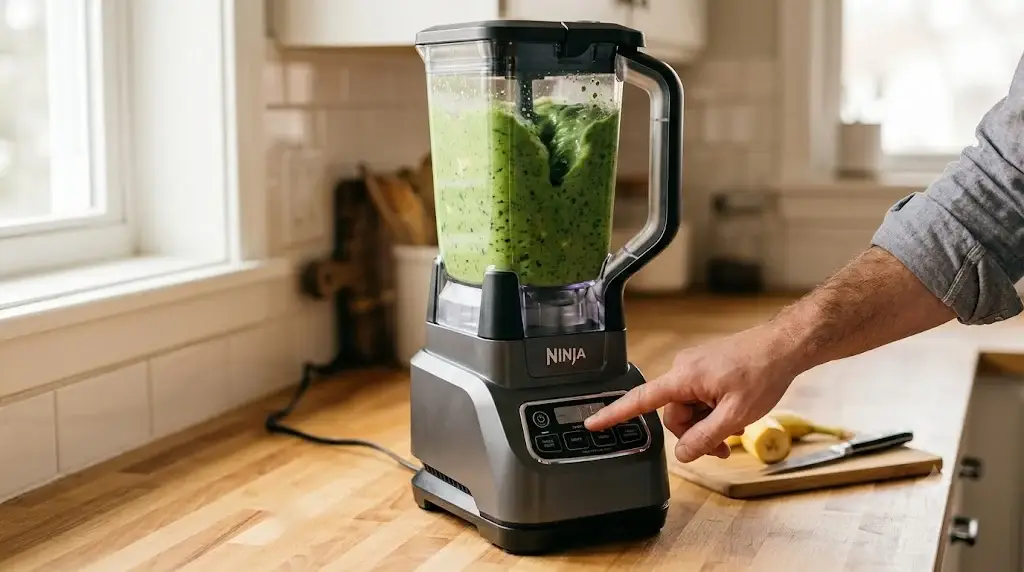
1. Ninja Professional Plus DUO (BN751)
This machine is a beast for the price. It comes with a 1400-peak-watt motor. That is plenty of power to crush ice into snow.
Pros:
+ Very strong ice crushing
+ Comes with single-serve cups
+ Easy preset buttons
Cons:
– Inside blade tower is sharp and hard to clean
– It is very loud
– Plastic parts can wear down over time
The coolest thing about this Ninja is the blade design. It does not just have a blade at the bottom. It has a tall tower with blades spinning at three different heights. This solves the air pocket problem because it hits the food at the bottom, middle, and top all at once.
But here is my warning from the one-star reviews: that blade tower is dangerous. If you are not careful when washing it, it will cut you. Paige thinks the design looks a bit blocky and industrial, but it works. You can view the full safety guidelines and parts breakdown directly on the official Ninja specifications page. It is an excellent pick if you make big batches for a family.
2. NutriBullet Pro 900
If you only make single-serve drinks for yourself, do not buy a massive countertop machine. It just wastes space. The NutriBullet Pro 900 sits in a small corner and does one job well.
Pros:
+ Small footprint on the counter
+ Easy to wash
– Drinks are blended right in the cup
Cons:
– Cannot handle large batches
– No buttons or speed control
– Can leak if you fill it past the max line
This machine has 900 watts of power. Because the cup is small, that power is concentrated. It forces everything through the blades fast. It liquefies berries and bananas in about thirty seconds.
The failure mode here is the rubber seal. If you pack too much ice or raw food in there, the pressure builds up. The liquid can leak down into the motor base. If you stay below the fill line, it lasts a long time. It is simple, cheap, and does not require an accounting degree to justify.
3. Breville the Fresh & Furious
Breville makes beautiful gear. Paige loves how this one looks on the counter. But I care about the motor and noise levels. The Fresh & Furious uses a special blade design that runs much quieter than the Ninja.
Pros:
+ Quieter than most budget blenders
+ Heavy-duty plastic pitcher resists cracking
+ Great for green smoothies
Cons:
– 1100 watts is lower than the Ninja
– Struggling with massive blocks of solid ice
This model shines when it comes to green drinks. It uses a curved bowl design at the bottom to stop food from hiding in the corners. It pulls spinach down smoothly.
Before using any plastic pitcher, I made sure to check the FDA regulations on food-contact plastics and BPA safety limits. Breville uses a high-grade plastic that does not hold onto stains or smells. If you want a smooth texture without waking up your entire house, this is the one to get.
[YOUTUBE EMBED: “Breville Blender Interface and Program Walkthrough” — Official Breville Channel — This shows how the preset buttons work and how loud the machine gets during a standard clean cycle.]
4. Oster Pro 1200
This is the budget pick for people who hate plastic. Almost every cheap blender today uses plastic jars. They scratch and get cloudy over time. The Oster Pro 1200 uses a heavy, thermal shock glass jar.
Pros:
+ Heavy glass jar is dishwasher safe
+ Low price point
+ Metal-to-metal drive system lasts longer
Cons:
– The base feels cheap and plasticky
– Small blade assembly can be slow
With 1200 watts, it has enough juice for regular daily use. It features a reversible blade setting. It spins forward, then backward to pull down stuck food.
The build quality on the outside base is not amazing. It feels like cheap plastic. But the connection between the motor and the blade is solid metal. That means it will not strip out like cheap plastic gears do. It is an honest, old-school machine that works.
How to Pack a Blender to Prevent Chunks
Even if you buy the best machine on the market, you can still ruin a drink if you pack it wrong. Order matters.
Think of it like building a house. You need a solid base. When I looked up official blending instructions, I studied the official Breville Fresh and Furious user guide to see how engineers recommend layering ingredients.
Here is the correct order from bottom to top:
- Liquids first: Milk, water, or juice goes at the very bottom. This gives the blades something to spin in right away.
- Powders and greens: Add your protein powder, chia seeds, and spinach next. The liquid will pull them down without letting them stick to the lid.
- Soft foods: Yogurt, peanut butter, and fresh bananas go here.
- Frozen items and ice: Place your hard frozen fruit and ice cubes at the very top. Their weight pushes the other ingredients down into the blade zone.
If you put the ice at the bottom, your blades will get stuck instantly. The motor will hum, get hot, and smell like burning wires. Save your motor by layering properly.
Frequently Asked Questions
Can these cheaper blenders crush solid ice without liquid?
No. Most budget machines need at least a splash of liquid to get moving. If you throw raw ice into an empty pitcher, the blades will just chip the bottom cubes and spin in place. The Ninja can handle dry ice better than the others because of its tall blade tower, but adding water or milk always gives a better result.
How long do these budget blenders last compared to a Vitamix?
A Vitamix can easily last ten to fifteen years. These alternative models usually last between two and five years depending on how hard you treat them. As an accountant, I look at the math. If you buy a one-hundred-dollar blender every three years, it takes twelve years to equal the cost of one Vitamix. For most people, keeping that money in the bank today is the smarter financial move.
Will a 900-watt blender get rid of kale strings?
Kale is tough. It has thick fibers that resist breaking. A 900-watt machine like the NutriBullet will chop it up, but you will still feel a tiny bit of texture. If you want completely smooth green drinks without strings, you need to let the machine run for a full sixty seconds, or step up to the Breville model which has better bowl circulation.
Are glass blender jars safer than plastic ones?
Both are safe if they are free from harmful chemicals. High-quality modern blenders use plastic that is certified safe for food contact. Glass is great because it does not scratch or absorb old fruit smells, but it can shatter if you drop it on a tile floor. Plastic won’t break if dropped, but it can get dull after years of scrubbing.
Why does my blender smell like it is burning when I use it?
This usually happens during the first few uses of a new machine. The motor has a protective coating from the factory that burns off as it gets warm. If the smell happens later on, it means the motor is straining. This happens if your mixture is too thick or if you did not add enough liquid to help the blades turn.
Can I make hot soup in a Ninja or NutriBullet?
Do not try to make hot soup in a standard sealed blender cup. The spinning blades create heat, which turns into steam pressure. If you use a sealed single-serve cup, the pressure can cause the lid to blow off, spraying hot liquid everywhere. If you want to blend warm food, use a large pitcher with a vented lid that lets steam escape safely.