Instant Pot vs slow cooker: Do you need both pans?
My first apartment kitchen had one skillet, one pot, and a plastic spatula that I am pretty sure came from a dollar store. Space was tight. If I bought a new gadget, something else had to go in the closet. So when everyone started talking about multi-cookers, my accountant brain immediately wanted to see the math.
The big selling point of the Instant Pot is that it replaces an entire shelf of appliances. The front panel has a button that literally says “Slow Cook.” On paper, that means you can donate your old ceramic slow cooker to a thrift store and save a foot of counter space.
But if you look at the one-star user reviews across the internet, you will notice a trend. People try to use that slow cook button for a ten-hour chuck roast while they are at work. They come home expecting a tender dinner, and instead, they find tough meat and crunchy carrots.
The truth is that these two machines are built entirely differently. They apply heat to your food in ways that do not match up. If you assume one can easily swap for the other, you are probably going to ruin dinner. Let us break down how they actually work, look at the test data, and figure out if you really need to own both.
How They Work: The Engineering Problem
To understand why an Instant Pot struggles to act like a traditional slow cooker, you have to look under the hood.
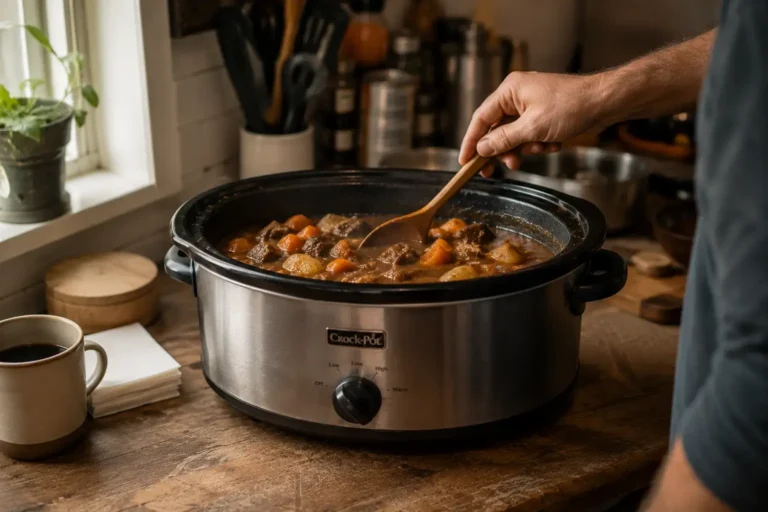
A traditional slow cooker is a very simple piece of machinery. It consists of a heavy ceramic or stoneware pot that sits inside a metal wrap-around heating base. When you turn it on, the heating elements inside the outer walls warm up. This means heat wraps completely around the stoneware insert. The heavy ceramic absorbs that heat and distributes it evenly from all sides. It creates a gentle, deep heat that keeps liquids at a steady simmer without scorching.
An Instant Pot is a pressure cooker first. It uses a thin, lightweight stainless steel inner pot. The heating element is a single electric plate located entirely at the very bottom of the base.
TRADITIONAL SLOW COOKER INSTANT POT BASE
Because the heat only comes from the bottom, an Instant Pot has to rely on liquid moving around to transfer heat upward. If you are pressure cooking, this works perfectly because the trapped steam builds massive pressure and forces heat into the center of the food. But when you use the slow cook setting, there is no pressure. The heat just sits at the bottom.
If your food is thick, or if you do not have enough water in the pot, the bottom gets hot while the top stays cool. That is why your vegetables stay hard and your meat stays tough.
The Temperature Disconnect
The second issue is the actual temperature settings. A classic slow cooker low setting usually hovers around 190°F, while the high setting gets up near 212°F over a few hours.
The standard settings on an Instant Pot do not align with these numbers perfectly. On many older models, the “Low” slow cook setting is actually closer to a keep-warm function, often staying under 170°F. If you leave meat at that temperature all day, it might never get hot enough to break down the tough connective tissue. In fact, if you look at the USDA food safety guidelines on slow cooker temperatures and safe handling, cooking food below 170°F for long periods risks keeping your meal inside the “danger zone” where bad bacteria can grow.
To get a true slow-cook low on an Instant Pot, you usually have to set the machine to “Medium” or “Normal.” To get a high setting, you have to choose “More” or “High.” Even then, because the steel pot loses heat through the sides much faster than a heavy ceramic pot, the cooking times take roughly 1 to 2 hours longer.
[YOUTUBE EMBED: “Instant Pot Slow Cooker Setting Test” — America’s Test Kitchen — Why this video adds value here]
Side-by-Side Comparison
Let us look at the practical details for both options. This table compares a standard 6-quart Instant Pot Duo against a classic 6-quart manual slow cooker.
| Feature | Classic Slow Cooker | Instant Pot (As a Slow Cooker) |
| Heating Style | Wraps around the sides and bottom | Bottom heating plate only |
| Pot Material | Heavy ceramic stoneware | Thin stainless steel |
| Heat Retention | High (ceramic holds heat well) | Low (steel loses heat quickly) |
| True Low Temp | ~190°F | Requires “Medium/Normal” adjustment |
| True High Temp | ~212°F | Requires “More/High” adjustment |
| Cooking Time | Standard recipe times apply | Add 1 to 2 hours to standard times |
| Searing/Browning | No (Must use a separate stove pan) | Yes (Using the built-in Saute function) |
When the Instant Pot Actually Wins
I do not want to sound like I hate the Instant Pot. I use mine frequently, but I use it for what it is actually good at: saving time through pressure.
If you are cooking dry beans, a pressure cooker is an absolute savior. Instead of soaking them overnight and simmering them for hours on the stove, you can throw dry black beans into an Instant Pot with some water and have them completely tender in about thirty minutes.
The same rule applies to tough cuts of meat like pork shoulder or beef chuck. A traditional slow cooker requires eight hours to break down the collagen in a pork butt for pulled pork. An Instant Pot can do that exact job in about 60 minutes under high pressure. The texture is slightly different—pressure cooking tends to compress the meat fibers a bit more compared to the loose, gentle fallback of a long slow simmer—but for a Tuesday night after a long work shift, it is an incredible trade-off.
Another massive win for the multi-cooker is the “Saute” button. If you want to make a stew in a classic Crock-Pot, you usually have to get out a separate skillet, brown your beef on the stove, wash that pan, and then dump the meat into the ceramic crock. With the Instant Pot, you brown the meat right in the bottom of the stainless liner, hit cancel, pour in your liquid to scrape up the browned bits, and then start cooking. It saves you from washing an extra dish, which my dish-hating soul appreciates.
When the Traditional Slow Cooker Wins
There are two distinct scenarios where the old-school ceramic pot cannot be beaten: unattended all-day cooking and delicate sauces.
If your goal is to dump ingredients into a pot at 7:00 AM, walk out the door for work, and return at 6:00 PM to a perfect meal, you want a slow cooker. The heavy ceramic structure is incredibly forgiving. It does not create hot spots, so your food will not burn to the bottom even if it sits there for ten hours. The wrap-around heat ensures that the entire contents of the pot reach a safe, even temperature together.
Slow cookers are also far superior for meals that need slow evaporation. The lids on traditional slow cookers fit loosely. They let a tiny amount of steam escape continuously while cooking. This helps sauces thicken up naturally over eight hours.
An Instant Pot lid is designed to create an airtight seal. Even when you leave the valve on the “Venting” position for slow cooking, the heavy locking lid traps a lot of condensation. That condensation drips right back into your food. If you try to make a thick pasta sauce or a concentrated curry using the slow cook button on an Instant Pot, you will often end up with a watery, thinned-out liquid that lacks depth.
Do You Actually Need Both?
For most people with normal-sized kitchens, owning both is completely unnecessary. It is just redundant gear taking up space. Here is how you should decide which one to keep or buy based on your specific style of cooking.
Keep Only the Traditional Slow Cooker If:
- You like to prep meals in the morning before work and want them ready the second you step through the door.
- You mostly make classic comfort foods like bone-in pot roasts, thick chilis, and dense stews.
- You do not care about cooking frozen meat or dry beans quickly on weeknights.
- You prefer simple appliances with a basic dial instead of digital menus.
A solid, reliable choice here is a basic 6-quart manual slow cooker. You do not need smart screens; you just need a heavy ceramic liner and a dial that turns from low to high.
Keep Only the Instant Pot If:
- You are a revisionist planner who decides what is for dinner at 5:30 PM.
- You cook a lot of rice, dry beans, chicken breasts, or quick soups.
- You do not mind adjusting recipes or adding extra cooking time when you occasionally want to slow-cook.
- You have very limited storage space and can only fit one large electric pot.
If you choose this path, I highly recommend buying a separate glass lid made specifically for the multi-cooker’s slow cook mode. Using the heavy, standard locking pressure lid blocks too much air and makes the heat problem worse. A clear glass lid lets the pot vent more like a real crock and lets you look at the food without losing heat.
Frequently Asked Questions
Can I use a standard slow cooker recipe in an Instant Pot on the pressure setting?
No, you cannot copy the times directly. A recipe that takes 8 hours on low in a slow cooker will usually cook in about 45 to 60 minutes under high pressure in an Instant Pot. You also have to ensure there is at least one cup of thin liquid (like water or broth) in the bottom. Pressure cookers require thin liquid to build steam and create pressure; if you copy a dry slow-cooker roast recipe that only calls for a splash of liquid, your Instant Pot will flash a “Burn” warning and shut down.
Why do my carrots stay hard when I slow cook in the Instant Pot?
Root vegetables like carrots and potatoes need high, sustained heat to break down their cell walls. Because the Instant Pot only heats from the bottom plate, and because the stainless steel inner pot loses heat quickly through its sides, the top half of the pot rarely gets hot enough to soften dense vegetables during slow cooking. If you are using the slow cook mode, make sure to cut your vegetables very small and place them at the very bottom of the pot, underneath the meat, so they sit directly over the heat source.
Is it safe to leave an Instant Pot on all day while I am at work?
Yes, it is electronically safe. Modern multi-cookers have built-in thermal sensors that shut the unit down if it gets too hot. However, from a food quality and safety perspective, you must make sure you are using the correct setting. Never use the “Less” or “Low” slow cook option for raw meat, as it may not keep the food hot enough to prevent bacteria growth. Always use the “Medium/Normal” setting for an all-day cook, and verify that the internal temperature of your meat reaches safe levels using a reliable digital food thermometer.
Why does my food taste bland when I use the pressure cook setting?
When you pressure cook, the airtight seal prevents any steam or aroma from escaping the pot. While this cooks the food incredibly fast, it also means no liquid evaporates, so your cooking juices do not concentrate or thicken. To fix this, always use the built-in “Saute” function after your pressure cooking cycle is finished. Leave the lid off and let the liquid simmer rapidly for 5 to 10 minutes to reduce and concentrate the flavors before serving.
Can I use the ceramic liner from my old slow cooker inside the Instant Pot?
Absolutely not. You must never use any inner pot other than the specific stainless steel or non-stick liner designed by the manufacturer for your exact multi-cooker model. The heating elements in an Instant Pot rely on direct, flat contact with the thin metal bottom of their proprietary liner. Putting a thick, heavy ceramic crock inside an Instant Pot base could crack the ceramic, destroy the electric heating plate, or cause a serious electrical fire.