How to safely store kitchen knives in a small space
Let’s talk about that giant wooden knife block sitting on your kitchen counter. If your kitchen looks anything like my first apartment, that block is currently taking up about 20% of your usable workspace. It sits there, heavy and slanted, holding eight knives you never use and maybe two that you actually do.
When you have a small kitchen, counter space is like gold. You need every inch just to chop an onion or set down a hot pan. But if you throw your loose knives into a random utility drawer to get them off the counter, you create a different problem. You risk slicing your fingers open when you reach for a spatula, and you will dull your blades as they bang against other metal tools.
You do not need a massive kitchen to keep your knives sharp and your fingers safe. You just need to change where and how you store them. Let’s break down the best ways to get those blades off your counter without creating a safety hazard.
Why the Standard Wooden Knife Block Fails Small Kitchens
Most people buy a knife block because it comes in the box with the knives. It feels like the default option. But for a compact kitchen, the classic countertop block is a terrible design for two big reasons: space efficiency and basic cleanliness.
First, there is the footprint. A standard 15-slot wooden knife block takes up a significant chunk of counter space. In a tight kitchen, that is space where you could put a cutting board or your morning coffee setup.
Second, those deep, dark wooden slots are nearly impossible to clean. If you put a knife away that is even slightly damp, moisture gets trapped inside the wood. According to home germ studies by organizations like the NSF, the kitchen knife block is one of the most frequently forgotten spots for regular cleaning, which can allow dust and mold to build up inside the slots where you cannot see it.
If you want to keep your kitchen sanitary and your counters clear, you need a storage method that lets you see the blades and wipe down the surfaces easily.
The Best Counterless Alternatives for Knife Storage
If you want to get your knives off the counter completely, you have two excellent choices: the wall or the drawer. Both methods keep the sharp edges hidden or secured while freeing up your workspace.
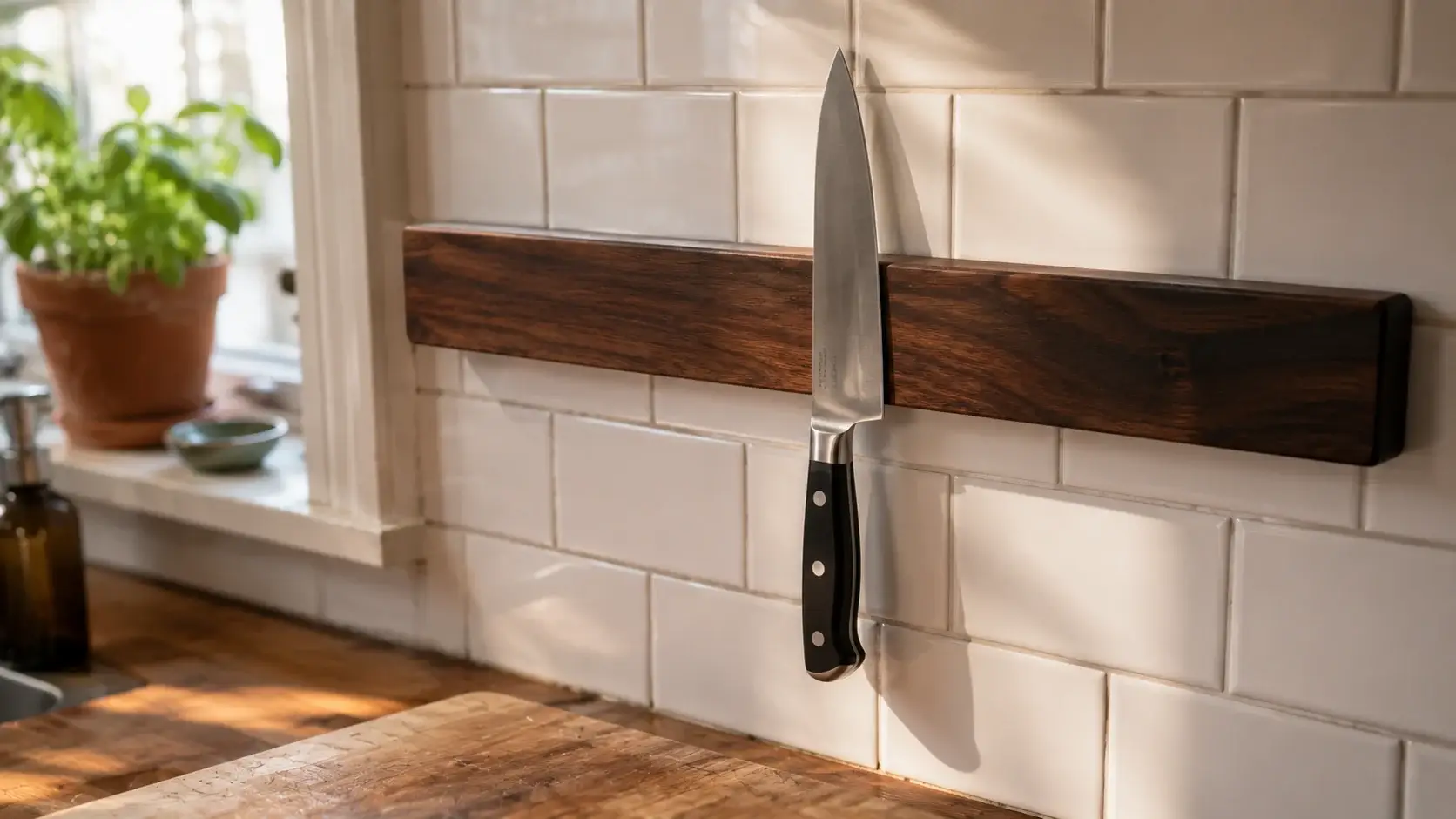
Magnetic Wall Strips: The Vertical Solution
A magnetic knife strip is a long bar that screws into your wall or backsplash. The magnets inside hold the flat side of your knife blade securely against the wall.
- The Big Benefit: It uses zero counter space and zero drawer space. It keeps your knives completely visible, so you never grab the wrong blade by mistake.
- The Safety Check: When practicing good kitchen safety, it is vital to have a designated storage area where knives are individually visible and kept out of the reach of children. A magnetic strip keeps them high up and out of the way.
- The Material Matter: Look for a magnetic strip wrapped in wood rather than bare stainless steel. Metal-on-metal scraping can scratch your blades or nick the sharp edge over time. A wooden exterior protects the steel.
In-Drawer Knife Organizers: The Hidden Solution
If you cannot drill holes into your apartment walls, or if you just prefer to keep your tools out of sight, an in-drawer knife organizer is your best bet. These are low-profile trays made of wood, plastic, or cork that sit flat inside a standard kitchen drawer. They have slots that hold the knives sideways or blade-down.
- The Big Benefit: Your counters stay completely empty, and the sharp edges are completely shielded inside the tray slots.
- The Safety Check: You can reach into the drawer with confidence because the handles face you, and the sharp edges point downward into the divider.
Comparing the Best Small-Space Knife Storage Options
To help you decide which setup fits your specific kitchen layout and budget, I put together this quick breakdown of the main options.
| Storage Method | Counter Space Used | Installation Effort | Best For | Average Cost |
| Magnetic Wall Strip | 0% | Medium (Requires drilling or strong adhesive) | Renters who can drill, open wall spaces | $20 – $45 |
| In-Drawer Organizer | 0% | None (Drops right into the drawer) | People with extra drawer space, families with kids | $15 – $30 |
| Universal Slim Block | Very Low (Under 4 inches wide) | None (Sits on counter) | Renters who cannot drill and have zero drawer space | $25 – $40 |
| Individual Blade Guards | 0% | None (Slides onto the knife) | People with only 2 or 3 good knives total | $5 – $12 |
What to Look for When Buying a Storage Solution
If you are ready to purchase a small-space storage solution, do not just buy the first cheap option with high star ratings on Amazon. I always check the one-star reviews first to see where a product fails. Here is what my accounting brain looks for before spending money on gear.
Checking Magnetic Strength
If you buy a magnetic strip, the magnet must be uniform across the entire bar. Cheap strips often use small, separate magnets inside with dead zones between them. If you place a heavy chef’s knife on a dead zone, it will twist or slide down. Look for brands like OXO or Wüsthof that use continuous magnetic fields.
Measuring Your Drawer Depth
Many people buy an in-drawer organizer only to find out their drawer will not close once the knives are inside. The handles of larger knives, like an 8-inch chef’s knife, sit high when placed in a tray. Before you buy, measure the vertical clearance of your kitchen drawer. Most standard trays require at least 3 inches of clearance depth to work safely.
Material Safety
Ensure any plastic or composite material you use is food-safe. If you buy a universal plastic rod block, check the manufacturer’s care page to make sure the insert can be removed and washed in the dishwasher. If you cannot wash it, it has the same sanitation issues as the old wooden block.
How to Store Your Knives If You Have No Extra Drawers or Walls
Sometimes a small kitchen has zero open wall space and every single drawer is packed with silver and towels. If that sounds like your kitchen, you can still store your knives safely without using a giant block.
Plastic Edge Guards (Blade Sheaths)
If you only own two or three good knives (which is all most home cooks truly need), you do not need a dedicated rack or tray. You can buy individual plastic blade guards. These are rigid sleeves that slide tightly over the blade. Once the guard is on, you can drop the knife into any regular utensil drawer. The edge stays sharp, and your fingers stay safe.
Slim Universal Blocks
If you must keep your knives on the counter, look for a universal slim block. These do not have pre-cut wooden slots. Instead, they are filled with hundreds of tiny, food-safe plastic rods or silicone dividers. You can push a knife into the block at any angle. They are usually less than 4 inches wide, meaning they take up a fraction of the space of a traditional wooden block.
Practical Tips to Maintain Your Knives in Tight Quarters
No matter which storage method you choose, your habits matter just as much as the gear. If you do not follow a few basic rules, you will ruin your blades or your storage inserts.
- Never put a wet knife away: Water trapped inside a drawer tray or on a magnetic strip can cause spots or rust on high-carbon stainless steel blades. Dry your knife completely with a towel immediately after washing.
- Place knives spine-first on magnetic strips: When you put a knife onto a magnetic wall strip, let the back of the knife (the spine) touch the bar first, then gently roll the blade flat. When taking it off, twist the knife slightly to lift the sharp edge off the bar first. This prevents the sharp edge from constantly striking the surface and dulling.
- Keep them out of the sink: Never toss your knives into a sink full of soapy water. It is a major safety risk for whoever washes the dishes, and the blade can get dinged by heavy pots. Wash your knives separately, dry them, and put them in their designated small-space storage spot immediately.
Small-Space Knife Storage FAQ
Are magnetic knife strips safe if I have pets or children?
If you have curious pets that jump onto the counter or small children who reach for edges, a magnetic strip requires careful placement. You must mount the strip high enough on the wall that it is completely out of reach. If you cannot guarantee that, an in-drawer organizer with a safety latch on the drawer is a much safer option for your home.
Will a magnetic strip magnetize my kitchen knives?
A magnetic strip will not permanently magnetize your steel knives, nor will it change the molecular structure of the metal. You might notice a very weak, temporary magnetic pull if you leave a knife on the bar for months without moving it, but it has zero impact on how the knife cuts, sharpens, or holds its edge.
How do I clean an in-drawer knife organizer?
Unlike traditional wooden blocks, in-drawer trays can be pulled completely out of the kitchen drawer. If it is made of wood or bamboo, wipe it down with a damp cloth and a drop of mild dish soap, then let it dry completely before putting it back. If it is plastic, you can usually wash it in the sink with warm water. Never put a wet tray back into a dark drawer.
Can I use adhesive tape to mount a magnetic knife strip?
Many heavy-duty double-sided tapes claim they can hold anything, but I do not recommend relying on them for loose knives. The constant pulling motion when you remove a knife puts stress on the adhesive. Over time, the tape can fail, causing the entire metal bar and several sharp knives to drop onto your counter or floor. Use the included screws and wall anchors whenever possible.
What is the absolute cheapest way to store knives safely in a small kitchen?
The most cost-effective solution is a set of individual plastic edge guards. You can buy a pack of four or five guards for under ten dollars. They protect your blades, keep your hands safe, and allow you to store your knives inside any drawer or container you already own without buying new furniture or drilling holes.


