Air fryer vs toaster oven: Which is easier to clean?
My sister Paige loves to look at pictures of beautiful kitchens. She spends hours scrolling through photos of neat counters with shiny appliances. Last week, she texted me a picture of a massive counter-top machine. It had ten different buttons and a bright glass door. She asked if she should buy it to save space in her house.
I texted her back a long note. I did not talk about how fast it cooks or how pretty the steel looks. I told her to look at the ceiling of the machine. I told her to think about what happens when bacon fat hits a fan spinning at top speed.
That is my accounting brain working. I work a regular desk job here in Findlay, Ohio. My degree is in accounting, which means I look for the hidden costs. I look for how things fail. Most review sites tell you how great a machine is when you first pull it out of the box. They show you a perfect chicken. But they do not show you the greasy muck you have to scrub out of the corner twenty minutes later.
When I got my first apartment, I knew nothing about cooking. I burned rice. I managed to ruin canned soup. But I learned fast that if a machine is hard to wash, you will stop using it. It will just sit on your counter and collect dust. If you are choosing between an air fryer and a toaster oven, the biggest question is not what they cook. The biggest question is how much you will hate cleaning them after you eat.
The Basic Design Difference (And Why Grease Cares)
To understand where the dirt goes, you have to look at how these machines are built. They both heat your food, but they do it in completely different ways.
How a Basket Air Fryer Handles Splatter
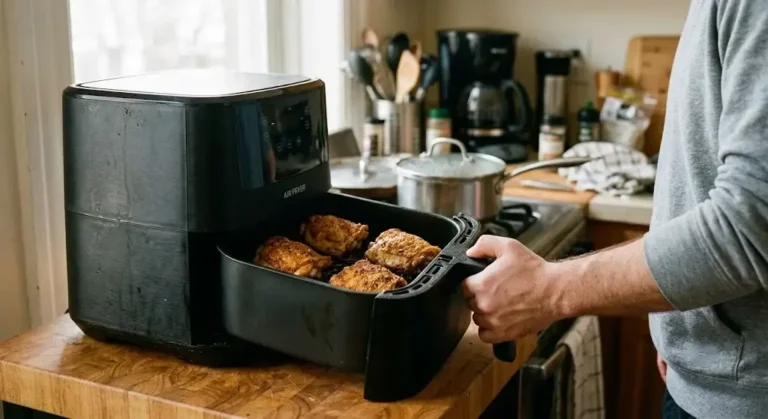
A standard basket air fryer is shaped like a little capsule. You pull out a big drawer by the handle. Inside that drawer sits a metal basket with holes in the bottom. Your food goes right into that basket.
When you turn the machine on, a small heating element at the very top gets hot. Directly above that element is a powerful fan. This fan blows air down at a very high speed. The air rushes past the heat, slams into your food, goes through the holes in the basket, and loops back up.
Because the space is so small, grease does not just sit there. The wind inside the machine picks up tiny drops of oil and throws them everywhere. The good news is that the basket catches most of the big drops. The bad news is that the fine mist of grease travels up. It coats the walls, and it coats the metal wire that protects the fan.
How a Toaster Oven Collects Grime
A toaster oven looks like a tiny version of the big oven in your kitchen. It has a front door made of glass that folds down. Inside, you have metal tracks on the walls where you slide in flat wire racks or baking sheets.
Most toaster ovens heat food using long tubes at the top and the bottom. These tubes get red hot and shine heat onto your food. Some newer models have a fan on the side or back to move the air around. But that fan is usually much slower than the one inside a basket air fryer.
When you cook something greasy in a toaster oven, the oil behaves differently. It drips straight down. If you do not put a pan under your food, it hits the bottom heating elements or the crumb tray. This causes smoke. The grease does not fly around the walls as much as it does in an air fryer, but it bakes onto the flat surfaces over time. It forms a hard, brown layer that feels like varnish.
The Daily Clean: Post-Dinner Reality Check
Let us talk about what happens on a Tuesday night when you are tired. You just finished eating three pieces of chicken. The plates are in the sink. Now you have to face the machine on your counter.
Washing the Basket vs Washing the Racks
Cleaning a basket air fryer after a normal meal is usually a fast job. Most baskets have a smooth coating that keeps food from sticking. You take the basket out, let it cool for a minute, and pour out any extra fat from the bottom of the drawer. Then you wash it in the sink with warm water, dish soap, and a soft sponge.
The shape is simple. It is just a big bucket. You do not have many tight corners to worry about. You wipe the inside, rinse it, and let it dry. If you hate hand washing, many brands say their baskets can go in the dishwasher. But my accounting brain tells me to read the fine print. To see what actually happens to non-stick materials over time under high heat, I looked up the formal technical definitions of PTFE on Wikipedia to see how detergent affects the coating. The harsh soap in dishwashers can wear that smooth layer away faster than hand washing.
Washing a toaster oven after dinner is a different story. You have to slide out the wire rack. If you cooked directly on the rack, you now have bits of food stuck to every single thin wire. Scrubbing a wire rack with a sponge is annoying. The sponge tears on the sharp edges.
You also have to pull out the flat baking sheet. If grease ran off the sheet, it is now sitting on the crumb tray at the very bottom of the oven. You have to slide that tray out without spilling loose crumbs or liquid grease onto your kitchen floor.
| Cleaning Task | Basket Air Fryer | Standard Toaster Oven |
| Time Spent After Dinner | 1 to 2 minutes | 3 to 5 minutes |
| Parts to Wash | 2 pieces (Basket and outer drawer) | 2 to 4 pieces (Rack, pan, crumb tray) |
| Sink Space Needed | Medium (Deep bucket shape) | Large (Flat, wide trays) |
| Risk of Sticky Corners | Low (Mostly rounded shapes) | High (Tracks and door seams) |
If you are just looking at the daily, simple wash, the basket air fryer wins. It has fewer loose parts, and the shapes are easier for a sponge to clean.
The Real Enemy: Baked-on Grease and Heating Elements
The daily wash is only half the story. The real trouble starts after two or three months of steady use. This is where the hidden design flaws show up. This is where I start reading the one-star reviews on Amazon to see what people complain about after owning a machine for a year.
Hidden Fans and Upper Elements
In a basket air fryer, the heating coil and the fan are hidden in the ceiling of the machine. You cannot see them unless you flip the whole appliance upside down.
Every time you cook something with high fat, like sausages or bacon, the violent wind inside blows oil upward. That oil hits the hot metal element and bakes on instantly. Over time, a thick layer of black carbon builds up around the fan blades.
Cleaning this area is incredibly difficult. You cannot submerge the top of the machine in water because of the electric wires. You have to wait until it is cool, turn it upside down on your counter, and scrub upward with an old toothbrush and a mix of baking soda and water. It is a messy job that leaves black water dripping down your arms. If you ignore it, the old grease will start to smoke every time you turn the air fryer on. Your kitchen will smell like stale oil.
Exposed Quartz Tubes vs Covered Metal Rods
Toaster ovens have their own nightmare zones. Most cheap or mid-range toaster ovens use long quartz tubes for heat. These tubes are made of glass and run across the top and bottom of the inside space. They are fragile. If you hit them hard with a metal pan or a scrub brush, they can crack.
Grease spits onto these tubes constantly. While the heat burns some of it off, a lot of it stays. You cannot use heavy chemical cleaners on them. You have to wipe them very gently with a damp cloth.
The biggest mess in a toaster oven happens on the walls and the glass door. The inside walls are usually made of cheap galvanized steel or aluminum. Grease coats these flat walls. Every time you use the oven, that grease gets baked again and again. It turns into a dark brown stain that feels like glue.
The glass door also catches a lot of grease. After a month, you can no longer see through the glass to check on your food. Cleaning that glass requires a razor blade or heavy scrubbing with strong soap, which can scratch the surface.
Cookware Coating Safety and Material Failure Modes
When you buy a kitchen machine, you need to know what materials are touching your food. My mom Linda used an old, heavy cast iron pan for almost everything. It did not have a chemical coating. It just got smoother the more she used it. But modern small appliances rely heavily on chemical coatings to keep food from sticking.
The Lifespan of Non-Stick Layers
Most basket air fryers use a coating made of PTFE or ceramic. This coating is what makes the daily clean so fast. Food slides right off. But these coatings do not last forever.
If you use metal tongs or a fork to grab your food out of the basket, you will scratch the surface. Once the non-stick layer is scratched, grease gets under the coating. It starts to peel. Food will begin to stick to those spots, and cleaning becomes twice as hard.
To make sure I was giving safe advice about these materials, I checked the FDA rules on food-contact coatings and safe materials to see how they handle non-stick chemicals. The main takeaway is that you must never use abrasive tools like steel wool on these baskets. Once the coating is gone, the basket is essentially ruined.
Many toaster oven accessories use cheaper steel plates without non-stick coatings. This means food sticks more easily, but you can scrub them harder without worrying about ruining a special chemical layer. You can use a metal scrubbing pad on a basic toaster oven sheet pan if you get desperate. You can never do that with an air fryer basket.
Real-World Scenarios: The Bacon and Reheated Pizza Test
Let us look at how these cleaning differences play out with real meals. I tested both machines in my own apartment using two common foods.
Scenario 1: Cooking Four Strips of Bacon
Bacon is the ultimate grease test. It releases a massive amount of liquid fat and spits wildly while cooking.
- In the Basket Air Fryer: I put the strips in the basket. The high fan speed cooks them fast and makes them perfectly crunchy. The fat drips through the holes into the outer drawer. When it is done, the bottom of the drawer holds a pool of hot grease. I let it cool, pour the liquid fat into a jar, and wash the two pieces. The basket kept the splatter contained, but a fine mist of oil reached the top fan.
- In the Toaster Oven: I put the bacon on the included baking sheet. Because the sheet is flat, the bacon sits in its own grease while cooking. It gets crispy, but the grease spits all over the glass door and the low heating elements. Cleaning involves washing the greasy tray, wiping down the glass door, and pulling out the crumb tray to catch the drops that escaped.
For high-grease foods, the air fryer basket keeps the mess inside a small, washable container. The toaster oven lets the mess spread across the entire inside chamber.
Scenario 2: Reheating Two Slices of Leftover Pizza
Pizza has grease from the cheese, but it also has loose crumbs from the crust.
- In the Basket Air Fryer: The slices have to be bent or cut to fit inside a standard round basket. The air blows the crumbs down into the drawer. The cheese melts nicely. Cleaning is just a quick rinse of the basket to remove a tiny bit of leaked cheese.
- In the Toaster Oven: The slices slide perfectly onto the wire rack. The crust gets incredibly crisp because the heat comes from directly underneath. A few crumbs fall through the rack onto the crumb tray. A drop of oil from the pepperoni drops onto the bottom heating element, creating a puff of smoke. Cleaning means pulling out the crumb tray and shaking the crumbs into the trash.
For dry or flat foods, the toaster oven is easy because the mess is just dry crumbs that wipe away. The air fryer is overkill for a few crumbs.
Finding the Right Balance for Your Kitchen Space
Choosing between these two machines often comes down to your physical kitchen layout. I live in a standard apartment. My counter space is limited. Every square inch has to earn its keep.
If you have a big family and cook large meals, a basket air fryer can be frustrating. You have to cook in small batches. If you try to crowd the basket, the air cannot circulate. Your food will end up soggy on the bottom, and the grease will stack up in thick layers between the pieces of food.
For a single person or a couple, the basket air fryer makes a lot of sense. It is fast, and the clean-up takes less than two minutes.
To ensure small appliances meet safety and cleanliness rules before they enter home kitchens, I checked the NSF standards for household kitchen equipment cleanability to see how easy they are to keep free of bacteria. They look at things like sharp internal corners where food can hide. Toaster ovens have many more of these tight seams and tracks than a simple, smooth air fryer basket.
If you want a machine that can toast four slices of bread at once, bake a small cake, and reheat an entire sub sandwich, you need a toaster oven. You just have to accept that you will spend more time wiping down the interior walls and dealing with flat trays.
Deep Clean Maintenance Without Ruining Your Appliance
If you want your machine to last, you have to do a deep clean every few weeks. Here is the safest way to do it for both types without breaking the parts or ruining the finishes.
Deep Cleaning the Basket Air Fryer
- Unplug the machine and let it cool completely.
- Mix two tablespoons of baking soda with one tablespoon of warm water to make a thick paste.
- Apply the paste to any stubborn grease spots inside the basket or drawer. Let it sit for ten minutes.
- Wipe the paste away with a soft cloth. Do not use metal scrubbers.
- To clean the upper element, mix a squirt of dish soap with warm water. Dampen a soft sponge and wipe the metal coil underneath the roof of the machine. Rinse with a clean, damp cloth.
Deep Cleaning the Toaster Oven
- Pull out the crumb tray, the wire racks, and the pans. Soak them in your sink with hot, soapy water for twenty minutes.
- Make a simple cleaning spray using equal parts white vinegar and water. Spray the inside walls and the glass door. Do not spray the heating elements directly.
- Let the spray sit for five minutes to break down the baked-on grease.
- Use a plastic scrubbing pad to clean the glass door and the steel walls.
- For the heating elements, use a completely dry toothbrush to gently brush away loose crumbs or burnt bits. Never use wet soap on quartz tubes.
Before using any strong cleaning chemicals on appliance interiors, I always read the USDA guidelines on food safety and kitchen surface sanitation to ensure no toxic residues can transfer to my food during the next high-heat cook. Stick to simple dish soap, vinegar, and baking soda. They are safe, cheap, and do not leave chemical fumes behind.
Frequently Asked Questions
Can I use aluminum foil in my air fryer to make cleaning easier?
You can use foil in an air fryer, but you have to be very careful. You must never place foil at the very bottom of the drawer underneath the basket. It will block the airflow and can cause the machine to overheat. You can put a small piece of foil inside the basket under your food, but you must ensure the food is heavy enough to weigh it down. If the foil lifts up, it can hit the spinning fan or the hot heating element and cause a fire.
Why does my toaster oven smoke when I use it?
Smoking usually happens because grease or food crumbs have fallen directly onto the bottom heating elements or onto the crumb tray right below them. Since those elements get incredibly hot, any oil that touches them burns instantly. To stop the smoke, unplug the machine, wait for it to cool, and slide out the crumb tray. Wipe away any pooled oil or burnt crusts. Also, check the glass door and walls for thick grease build-up that might be cooking every time the oven heats up.
Is a ceramic air fryer basket easier to clean than a PTFE one?
Ceramic baskets are popular because they do not use traditional plastic-based non-stick chemicals. In terms of daily washing, they perform very similarly to PTFE when they are new. Food slides off easily. However, ceramic coatings can lose their non-stick properties a bit faster if they are washed in a dishwasher or exposed to sudden changes in temperature, such as pouring cold water into a hot basket. Hand washing with mild soap keeps both types working well for a long time.
How do I clean a toaster oven that has a non-stick interior?
Some high-end toaster ovens have coated interior walls that are designed to shed grease. To clean these, you should never use harsh oven cleaner sprays or abrasive metal pads. Wipe them down after every use with a soft sponge and mild dish soap. If grease bakes onto the coating, use a paste of baking soda and water to gently lift the stain. If you scratch the interior coating, grease will stick to the scratches and become almost impossible to remove.
Can I put my toaster oven racks in the dishwasher?
Most manufacturers say you can put steel wire racks in the dishwasher, but it is usually better to wash them by hand. The high heat and intense water spray in a dishwasher can cause some metals to discolor or develop small rust spots over time, especially at the points where the wire rods are welded together. A quick soak in hot water with standard dish soap will soften most stuck-on food, allowing you to wipe it away easily with a plastic scrub brush.