Less Smoke? Best Grill Pans for Indoor Cooking Tested
Let’s be honest about indoor grilling. Most of what you see on social media is a flat-out lie. A gorgeous piece of ribeye gets dropped onto a pristine, ridged pan, perfectly uniform char marks appear in seconds, and the kitchen looks like a clean, sunlit sanctuary.
My reality—and probably yours—usually looks a lot different. The first time I tried making burgers on a cheap aluminum grill pan in my college apartment, I didn’t get a gourmet dinner. I got a smoke alarm that wouldn’t stop screaming, grease splattered all over my countertop, and a pan that took three days of soaking to clean. I managed to overcook the meat while keeping it completely gray on the outside. It was a disaster.
My background is in accounting, not culinary school. I look at kitchen gear through a strict lens of cost-per-use, failure modes, and historical performance data. I don’t care if a pan looks pretty on a grid layout; I care if it holds heat, handles thermal shock, and cleans up without destroying your afternoon.
My sister Paige kept sending me pins of beautiful, enameled grill pans, asking if they were worth the $150 price tag. My response was a giant wall of text breaking down cast iron physics. She told me to just write it down for the site.
So, let’s look at the numbers. If you want outdoor flavor indoors, you are looking at a specific tool. After running the spreadsheets, reading hundreds of frustrated one-star customer complaints, and ruining a fair share of protein, I’ve broken down the best grill pans for indoor cooking based on how they actually perform when the exhaust fan is running on high.
The Reality of Indoor Smoke Points and Pan Materials
The single biggest complaint people have with indoor grilling is smoke. When fat hits a hot surface, it reaches its breaking point. To get those beautiful, dark sear lines, the ridges of your pan need to be incredibly hot—often sitting between 400°F and 450°F.
Here is where the chemistry catches up to you. If you are using a light, thin aluminum pan, the heat transfers almost instantly, but the pan drops in temperature the second you drop a cold steak onto it. To compensate, you crank up the stove burner. The low spots of the pan—where the grease drains—get wildly hot, causing the collected fat to pass its smoke point immediately.
Material thickness and weight matter far more than brand names here. Heavy cast iron acts like a thermal battery. It holds onto heat so efficiently that when meat hits the ridges, the temperature stays stable, meaning you don’t have to push your burner to its absolute maximum just to get a decent sear.
Heavyweight Heavy Duty: The Cast Iron Contenders
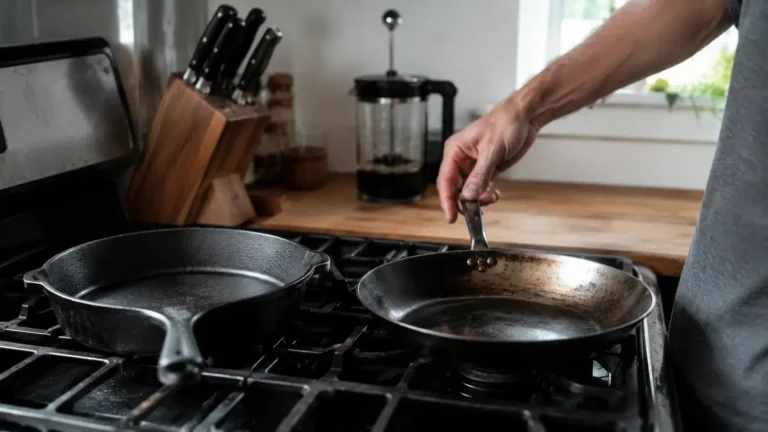
When you want serious heat retention, unseasoned or pre-seasoned bare cast iron is the traditional choice. It can handle extreme temperatures without warping, and it doesn’t rely on chemical coatings that degrade over time.
Lodge Cast Iron 10.5-Inch Square Grill Pan
If you want something that will outlive your current kitchen, this is the benchmark. It is a solid, heavy piece of American-made iron that costs less than a decent takeout meal.
- The Math: The square design gives you roughly 25% more cooking area than a standard round pan of the same width, meaning you can actually fit two full-sized steaks without crowding them.
- The Reality Check: It arrives pre-seasoned, but bare cast iron is inherently porous. It takes time to build a truly slick surface. For the first few months, you will need to use a bit more oil than you think, and you absolutely cannot throw it in the dishwasher.
To prevent this pan from turning into a rusted square of scrap metal, I followed the manufacturer’s direct advice. After washing it, I make sure to use a light coat of vegetable oil on the iron after every wash as recommended by Lodge Cast Iron’s official care guide to protect it from humidity.
[YOUTUBE EMBED: “How to Clean and Season a Cast Iron Grill Pan” — Lodge Cast Iron — This video shows the exact technique for getting sticky residue out from between the tight ridges without stripping your seasoning.]
Le Creuset Enameled Cast Iron Signature Square Skillet Grill
This is the high-end alternative Paige kept sending me. It takes the heavy heat retention of cast iron and coats it in a dark matte enamel.
- The Math: You do not have to season this pan. It won’t rust if you leave it wet in the sink for an hour, and it handles acidic marinades (like a lemon-herb chicken) that would strip the seasoning off a bare Lodge pan.
- The Reality Check: It costs five times more than standard cast iron. From a pure value-per-dollar standpoint, the math is hard to justify for someone just starting out. The enamel surface creates beautiful char marks, but it is not a slick non-stick pan; food will still catch if your temperature control is off.
The Non-Stick Alternative: Convenience vs. Longevity
A lot of home cooks want the grill lines without the heavy lifting or the cleanup stress. That is where non-stick options enter the picture. However, this convenience comes with a strict technical limitation.
Anolon Advanced Hard-Anodized Nonstick 11-Inch Deep Square Grill Pan
This pan uses a thick, heavy-gauge aluminum base that prevents the classic hot spots common in cheap discount-store pans.
- The Math: The ridges are high enough to lift the meat entirely out of the pooling grease, and clean-up takes about 45 seconds with a soft sponge.
- The Reality Check: Non-stick coatings are fundamentally temporary. Standard polytetrafluoroethylene (PTFE) coatings cannot handle the searing heat that bare iron thrives on.
When you look at the material science, you realize you have to treat these pans carefully. To understand what these coatings can safely handle, I reviewed the structural details on Wikipedia’s technical breakdown of PTFE chemistry and heat resistance, which highlights that these materials begin to alter structure if pushed past 500°F. If you overheat an empty non-stick grill pan trying to get maximum char, you will destroy the coating long before the year is out.
[YOUTUBE EMBED: “Nonstick vs Cast Iron Grill Pans Test” — America’s Test Kitchen — This video shows the stark difference in crust formation and browning between a non-stick coating and heavy iron.]
Head-to-Head Comparison: Finding the Real Value
To see how these options stack up for an everyday kitchen setup, I built out a comparison based on weight, ridge depth, and ease of care.
| Grill Pan Model | Material Base | Weight | Ridge Height | Seasoning Required? | Best Suited For |
| Lodge 10.5″ Square | Pre-seasoned Cast Iron | 6.5 lbs | High (Deep channels) | Yes (Ongoing) | The budget-conscious cook who wants maximum sear |
| Le Creuset Signature | Enameled Cast Iron | 6.0 lbs | Medium-High | No | The cook who hates seasoning but wants heavy iron |
| Anolon Advanced 11″ | Hard-Anodized Aluminum | 2.8 lbs | Medium | No | Apartment renters who prioritize fast, easy cleanup |
The Smoke Problem: How to Use These Pans Without Blasting the Alarm
If you place a dry steak onto a cold pan, turn the burner to high, and pour in a tablespoon of olive oil, you are going to fill your home with white smoke. Olive oil has a low smoke point (~375°F), meaning it breaks down and burns well before your iron gets hot enough to create an actual sear.
Instead, change the workflow:
- Dry the Meat: Moisture is the enemy of a sear. Wet meat steams instead of browning, giving you that unappetizing gray color. Use a paper towel to remove every drop of surface water.
- Oil the Food, Not the Pan: Instead of pouring oil into the channels of the pan—where it will just sit, smoke, and burn—lightly brush a high-smoke-point oil (like canola or avocado oil) directly onto the meat.
- Verify Internal Doneness: Don’t guess when your meat is done based on the outside lines. To make sure you’re serving safe food without overcooking it to leather, I always double-check the safe minimum internal cooking temperatures published by the USDA to guarantee accuracy for steaks (145°F with a rest) and chicken (165°F).
Before buying into any marketing hype regarding “completely smokeless” stovetop pans, it pays to check the safety science. To protect your home’s air quality, I checked out the consumer safety tips on Healthline regarding non-stick pan overheating limits, which clearly notes that keeping windows open and avoiding preheating empty coated pans is the best way to prevent kitchen fumes.
Authentic Answers: Stovetop Grill Pan FAQ
Do indoor grill pans actually give you outdoor barbecue flavor?
No, they don’t, and anyone telling you otherwise is trying to sell you a pan. True outdoor BBQ flavor comes from charcoal smoke, vaporized wood chips, or wood sugars dripping down onto an open flame and rising back up into the meat. An indoor pan cannot replicate that chemical process. What an indoor grill pan does do is provide intense, concentrated contact heat along the raised ridges while allowing excess fat to drain away into the valleys, giving you excellent texture, beautiful presentation lines, and a deep crust without boiling the meat in its own juices.
Why does my chicken always stick to the ridges of my cast iron grill pan?
Sticking usually happens for two reasons: the pan wasn’t fully preheated, or you tried to flip the chicken too early. When cold meat hits a properly hot iron surface, it undergoes a chemical reaction that eventually coaxes the proteins to naturally release from the metal. If you try to lift the meat before that crust forms, you will tear the chicken apart. Give it three to four minutes without moving it. Additionally, because the contact area on a grill pan is limited to the very top of the thin ridges, those specific points need a solid foundation of baked-on fat. If your pan is relatively new, rub a microscopic layer of high-heat oil onto the ridges before turning on the stove.
Are round or square grill pans better for small apartment stoves?
Square pans are structurally better for optimizing your actual cooking surface. A 10-inch square pan offers significantly more usable flat space than a 10-inch round pan because the corners give you extra room for items like asparagus spears, long strips of bacon, or multiple burgers. However, if you are working on a very old, small electric coil stove or a cramped apartment range, the corners of a square pan might hang off the edge of the heat source, creating cooler zones. For standard gas burners or modern flat induction tops, go with the square pan every time.
How do you get burnt, sticky marinade out of the ridges without ruining the pan?
Never use harsh steel wool or abrasive metal scrapers on your pan’s coating. For bare cast iron, let the pan cool down until it’s warm but comfortable to handle. Pour in a half-cup of coarse kosher salt and use a stiff-bristled plastic brush or a dedicated plastic pan scraper to scrub down the channels. The salt acts as a natural, food-safe abrasive that breaks up caramelized sugars without stripping away your hard-earned seasoning layer. If things are truly cemented on there, simmer plain water in the pan on your stove for three minutes to loosen the debris, dump it out, and dry the iron immediately over a warm burner.