What size dutch oven do you actually need? (Don’t Overbuy)
I built a spreadsheet before buying my first $40 sauté pan. If that sounds like overkill, blame my accounting background. I look at kitchen gear the way I look at a balance sheet: I want to know the liabilities, the hidden costs, and the exact point where paying more stops giving you a better return.
When you start looking online for a piece of enameled cast iron, you run into a brick wall of copy-pasted advice. Almost every single blog out there tells you the exact same thing: “Buy a 6-quart pot. It is the perfect size.” They say it like it is a universal law.
But a 6-quart cast iron pot weighs roughly 12 to 14 pounds when it is completely empty. Fill that same pot with a batch of my mom’s Sunday pot roast, and you are suddenly hauling 20 pounds of burning-hot metal out of a low cabinet. If you have a small double-basin apartment sink like mine, washing a monster like that feels like trying to bathe a bowling ball.
You do not want to spend $80 to $300 on a heavy block of iron only to realize you hate lifting it. At the same time, you do not want to buy a tiny pot where your beef chunks end up crowding together and steaming instead of getting that deep, dark crust.
Let’s break down the actual numbers, the real-world measurements, and the math behind finding out what size dutch oven do you actually need without overbuying.
The Lazy Rule of Thumb vs. Real Life Math
Most cookware brands love to give you a simple formula: one quart per person. By that logic, if you live alone or with a partner, a 2-quart or 3-quart pot should be plenty.
That math is fundamentally broken. It only works if you are filling the pot to the absolute brim with water, like a kettle. In real life, you need empty space inside the pot.
When you sear a piece of meat, moisture escapes. If the walls of your pot are too close to the food, that moisture traps itself inside the cooking zone. Instead of getting a crisp, browned surface, your meat boils in its own juices. To prevent this, you need a pot with a wide base diameter, not just a deep vertical volume.

[YOUTUBE EMBED: “How to Sear Meat Correctly for Stews” — America’s Test Kitchen — This video shows exactly how much space meat needs to brown properly instead of steaming.]
You also have to look at the physical shape of what you cook. A standard 4-pound whole chicken does not care about your quart capacity; it cares about width. It will not sit flat in a deep, narrow 3-quart pot. It will wedge itself against the sides, leaving the bottom untouched.
To find the right fit, you have to look at the intersection of volume, base diameter, and what you actually cook on a Tuesday night.
The Definitive Capacity Breakdown
To keep you from buying more metal than your shelves can handle, I mapped out the four main size tiers. These are based on real-world cooking tests, not corporate marketing sheets.

The Small Tier: 2 to 3.5 Quarts
This is the neighborhood of specialty pots. If you see a tiny, cute 2-quart round cocotte on Pinterest, it looks great in photographs. In practice, it is highly limited.
- Who it is for: People living alone, couples who never want leftovers, or home cooks who only want a dedicated vessel for side dishes, warm dips, or small batches of grains.
- The Reality Check: You cannot easily fit a whole bird or a standard batch of soup in here. If you try to make a basic sauce, you will constantly fight splashes over the rim.
The Medium Tier: 4 to 5.5 Quarts
This is what I call the high-utility sweet spot for small households. If you are worried about the physical weight of cast iron but still want to cook actual meals, this is where you start looking.
- Who it is for: Households of 2 to 3 people, or apartment cooks with limited cabinet space and smaller sinks.
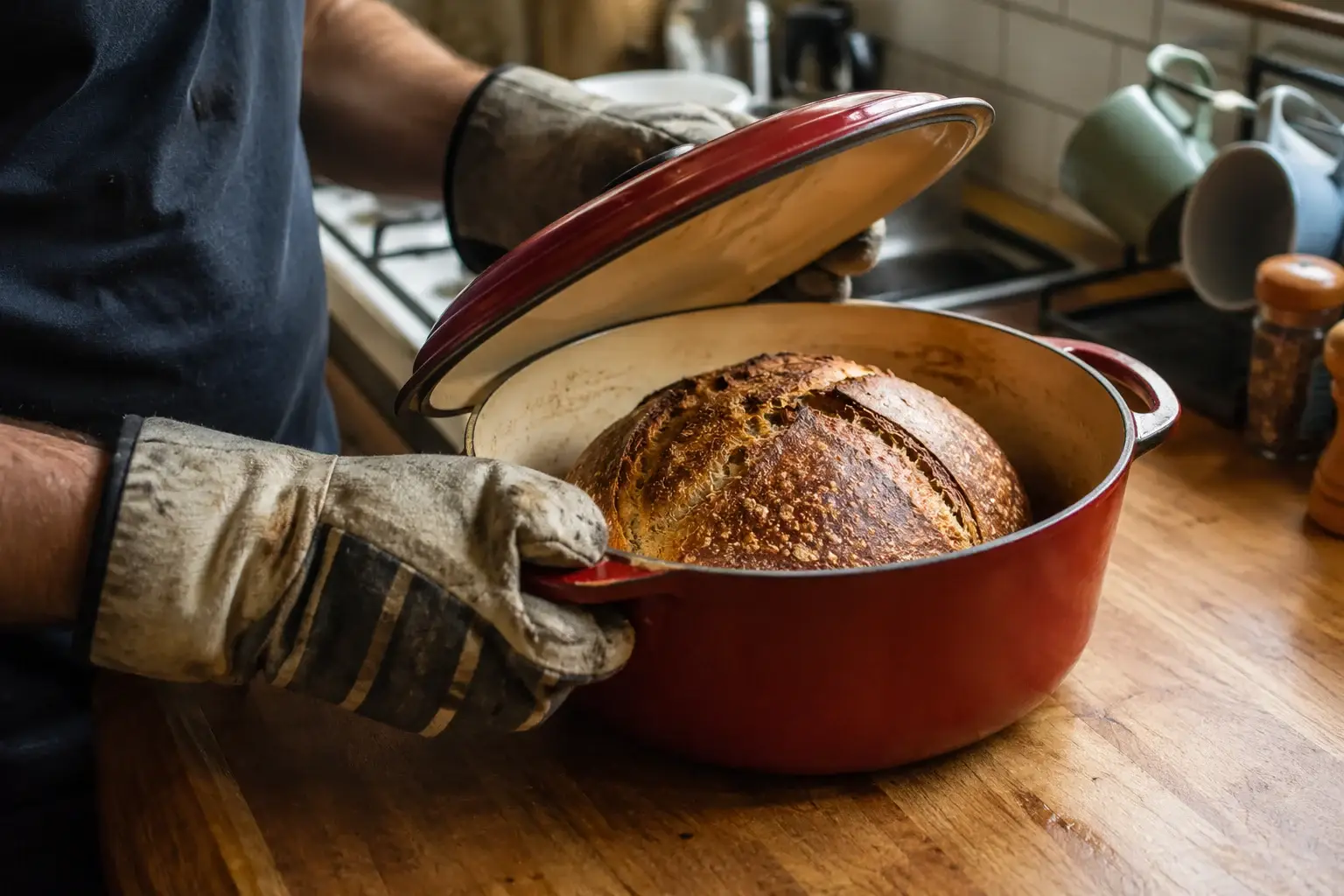
- The Reality Check: A 4.5-quart round pot typically has a base diameter of around 10 inches. That is wide enough to sear three large chicken thighs at the same time without crowding them. It fits a 3-pound beef chuck roast beautifully. It is also the classic size for baking a standard loaf of no-knead sourdough bread.
The Large Tier: 6 to 7.5 Quarts
This is the industry standard recommendation, but it comes with serious physical baggage.
- Who it is for: Families of 4 to 6 people, dedicated meal-preppers who want a full week of lunches cooked at once, or anyone who frequently braises large pork shoulders and whole chickens.
- The Reality Check: A 6-quart pot gives you roughly 11 inches of cooking diameter. It handles large volumes without breaking a sweat. However, you must look at the weight specs before you buy. If you have any wrist or back issues, washing this piece of gear every day will quickly become a chore you actively avoid.
The XL Tier: 8+ Quarts
Unless you are running a catering business out of your kitchen or feeding a literal crowd every single weekend, step away from the spreadsheet.
- Who it is for: Large families of 7 or more, or holiday-only cooking.
- The Reality Check: These pots are incredibly heavy and wide. On a standard residential stove burner, an 8-quart pot will overhang the heating element significantly. Because cast iron conducts heat slowly, you can end up with a blazing hot center and cold outer edges if your burner is too small.
| Pot Capacity | Base Diameter (Avg) | Empty Weight (Avg) | Best Used For | Ideal Feed Size |
| 2 – 3.5 Quarts | 7″ – 8.5″ | 5 – 7 lbs | Oatmeal, side grains, single-serve sauces | 1 – 2 People |
| 4 – 5.5 Quarts | 9.5″ – 10″ | 9 – 11 lbs | Standard bread loaves, 3lb roasts, everyday soups | 2 – 3 People |
| 6 – 7.5 Quarts | 10.5″ – 11.5″ | 12 – 14 lbs | Whole chickens, large batches of chili, meal prep | 4 – 6 People |
| 8+ Quarts | 12″+ | 16+ lbs | Stockpot volumes, massive holiday gatherings | 7+ People |
The Bread Factor: Oval vs. Round Ovens
If you are buying a dutch oven specifically because you want to bake bread, the geometry of the pot changes the game completely.
Round pots are the undisputed champions for classic round boules. The uniform walls push heat evenly toward the center of the dough. When you drop a round loaf into a 4.5-quart or 5.5-quart round pot, the shape naturally supports the rise, giving you that tall, airy interior crumb.
Oval pots are designed with long cuts of meat in mind, like a whole beef brisket or a large turkey breast. They also happen to be perfect for baking long, oval batard loaves.
If you buy an oval pot for everyday cooking, remember that standard stovetop burners are round.
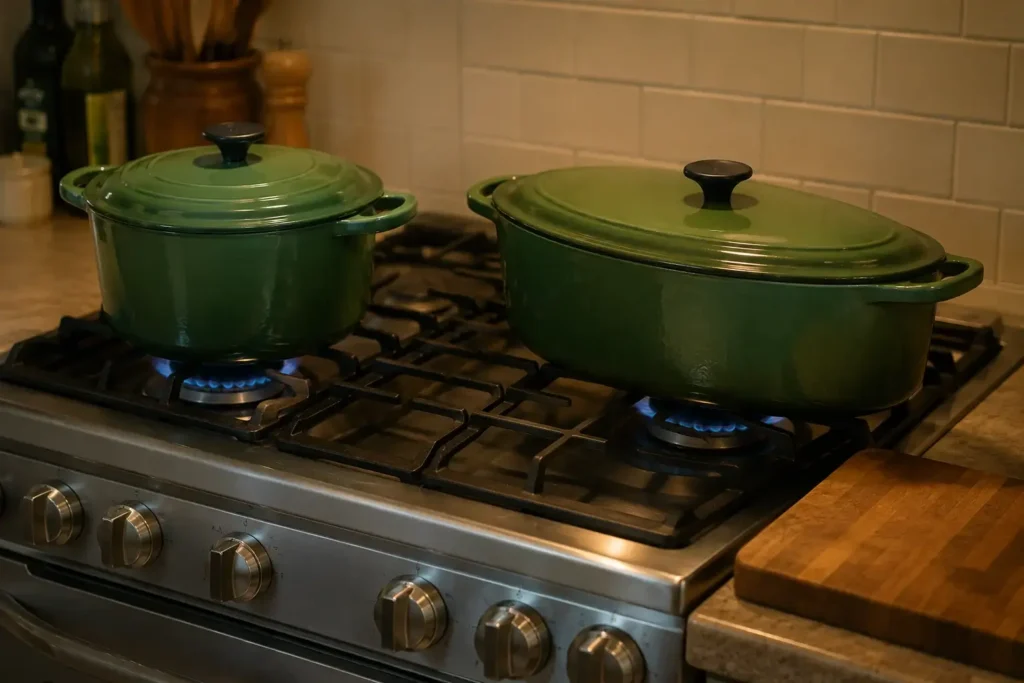
Because cast iron does not distribute heat as fast as copper or aluminum, the elongated ends of an oval pot sitting on a round burner will naturally run cooler than the center. To make sure my reporting was solid before writing this, I checked the technical metallurgy guides on Wikipedia regarding cast iron thermal conductivity [opens in new tab] to confirm how heat moves through the metal. The data shows that cast iron relies heavily on its mass to retain heat because its actual thermal conductivity rate is relatively low compared to aluminum. If you use a large oval pot on a small burner, you will have to let it preheat for a full 10 to 15 minutes to let that heat creep out to the far edges.
Reading the One-Star Reviews: What Can Go Wrong?
My accounting brain forces me to look for the failure modes of any product before I look at the benefits. When you browse the glossy pages of high-end cookware brands, everything looks indestructible.
To find the truth, I spent hours reading through the lowest ratings on popular models. When people hate their dutch oven, their complaints almost always fall into three categories:
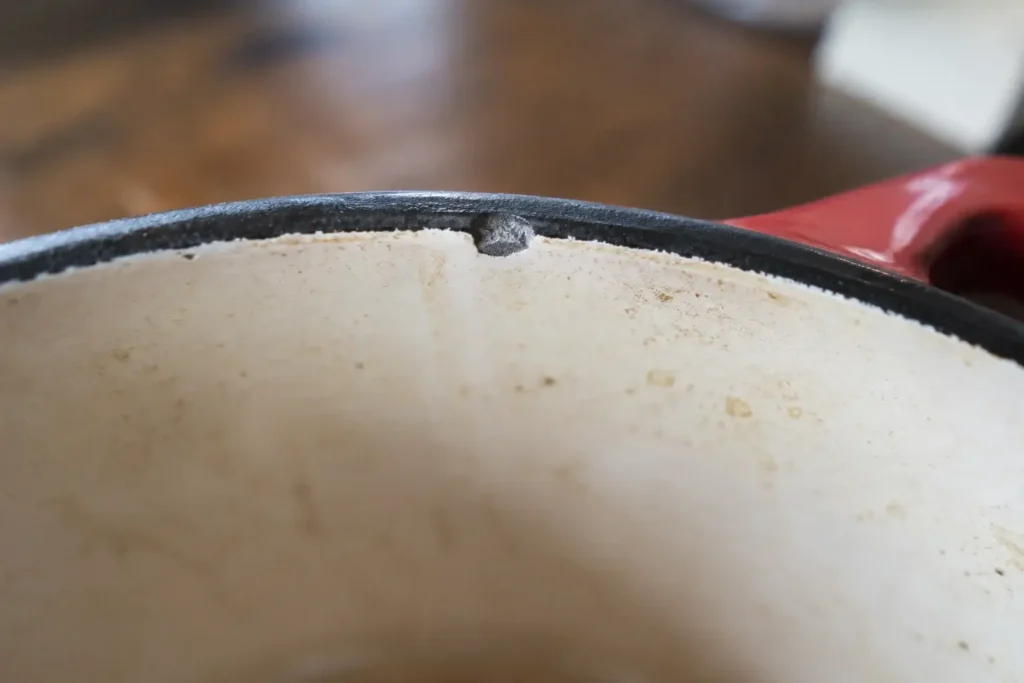
- Enamel Chipping at the Rim: This is the number one complaint for mid-tier pots. Enameled pots have a glass coating baked onto the iron. The rim is the most vulnerable spot. If you bang the lid down too hard or store the pot bare-metal-to-metal without protective spacers, that glass will flake off.
- Exterior Discoloration: People get furious when their bright, beautiful pink or blue pot turns brown or black on the bottom after two uses on a gas stove. This is usually caused by cooking over high flames or allowing oil residue to bake onto the exterior.
- The Glass Knob Trap: Some brands ship their pots with plastic or low-temperature resin knobs on the lid. If you pop that pot into a 450°F oven to bake bread, those knobs can crack or melt.
If you want a pot that lasts, look closely at the specifications.
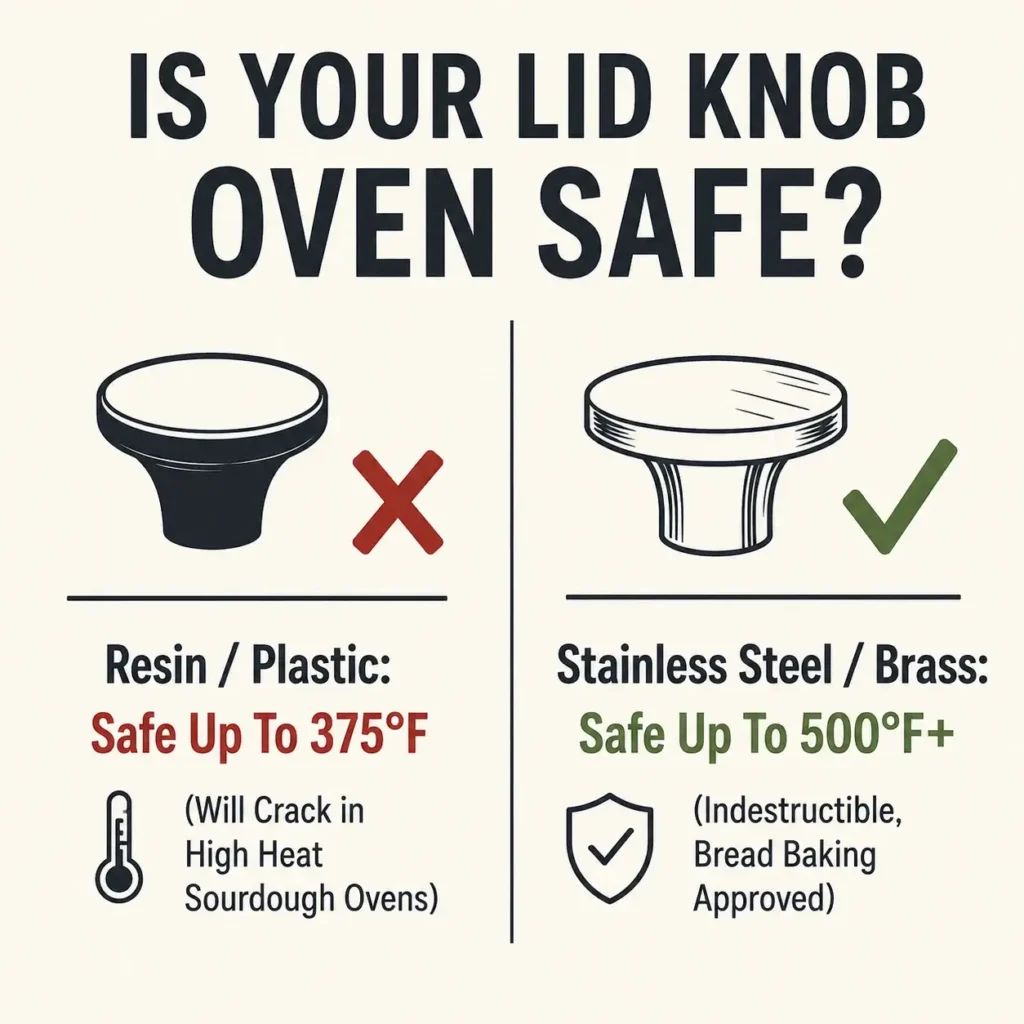
For example, before putting any piece of enameled iron into a high-heat oven, I read through the official Lodge Cast Iron use and care guidelines [opens in new tab] to verify their exact safety limits. Their classic enameled line is rated safe up to 500°F, but they explicitly warn users that the standard stainless steel knobs can handle that heat, while older or alternative resin components may have lower thresholds. Always check the knob material before you crank your oven for sourdough.
Real Options for Real Budgets
You do not need to drop a entire week’s paycheck to get a functional piece of iron. Let’s look at three specific paths based on what you actually want to spend.
The Investment Path: Staub or Le Creuset
These are the French heritage brands. If you buy a 5.5-quart round Le Creuset or a Staub 5.5-quart Cocotte, you are paying for premium glass enamel formulations. Their coatings are much less prone to thermal shock cracking, and the castings are thinner, which makes them slightly lighter than budget competitors.
- Who it is for: Anyone who plans to use their pot multiple times a week for the next twenty years and wants something they can eventually pass down to their kids.
The Value Path: Lodge Enameled Cast Iron
Lodge makes their bare cast iron in Tennessee, but their enameled line is manufactured in China to keep costs down. A Lodge 4.5-quart or 6-quart enameled pot costs a fraction of the French brands.
- The Breakdown: The enamel coating is thicker and slightly more prone to minor staining than Staub, but from a pure heat-retention and cooking performance perspective, it delivers identical results. It uses a sturdy stainless steel knob that can handle high bread-baking temperatures right out of the box. It is the exact brand I bought after running my own spreadsheet comparisons.
The No-Enamel Alternative: Bare Cast Iron
If you are terrified of chipping a delicate glass coating, skip the enamel entirely. A traditional, pre-seasoned bare cast iron dutch oven is virtually indestructible. You can drop it on concrete, scrape it with a metal spoon, and use it over an open campfire.
[YOUTUBE EMBED: “How to Restore and Season Bare Cast Iron” — Lodge Cast Iron — A visual guide showing how to build a natural non-stick seasoning layer on unenameled iron.]
- The Trade-off: You cannot leave highly acidic foods, like a slow-simmering tomato marinara, inside a bare iron pot for hours. The acid will eat away at your seasoned oil layer and give your sauce a metallic tang. For pure safety metrics on food interaction, I looked into the USDA food preparation and container safety guidelines [opens in new tab] to see how bare metals interact with acidic food environments over long cooking cycles. If you want a pure utility pot for stews, bread, and frying, bare iron is cheap and impossible to break.
How to Test Your Kitchen Architecture Before Buying
Before you hit the buy button on Amazon, you need to audit your physical workspace. Do not just trust the dimensions listed on the product page. Take out a tape measure and check these three points:
Your Sink Clearance
Measure the inside of your kitchen sink basin. A 6-quart round pot with handles can measure over 13 inches wide from ear to ear. If your sink basin is only 12 inches wide, you will never be able to sit the pot flat in the bottom to soak it.

You will be forced to tilt it at an angle, splashing soapy water all over your countertop every single time you clean it.
Your Oven Rack Height
Cast iron lids have tall knobs. A large pot can easily measure 7 to 8 inches tall with the lid on. If you have a small apartment oven, that pot might require you to move your oven racks to their lowest possible slots, leaving zero room to cook anything else at the same time.
Your Muscle Memory
Go to your kitchen cabinet right now and pick up your heaviest current pan. Weigh it on a simple digital scale if you have one. If your heaviest pan is a 3-pound aluminum skillet, jumping straight to a 13-pound empty cast iron pot is going to feel like a shock to your wrists.
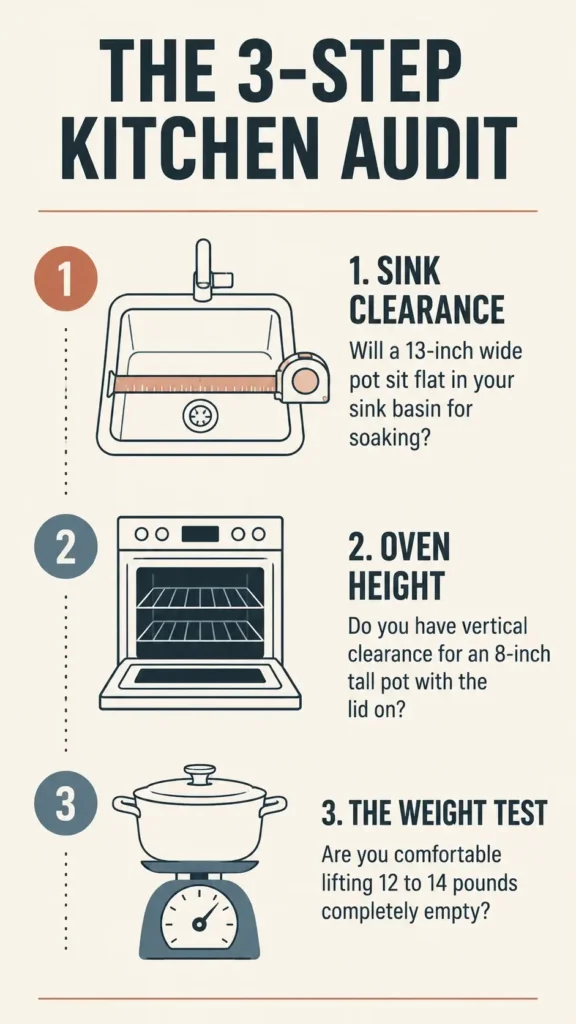
If you aren’t comfortable lifting that weight with two hands, scale down to a 4.5-quart model.
Dutch Oven Size FAQs
Is a 4-quart dutch oven too small for a family of four?
Yes, for most cooking styles it will feel cramped. While a 4-quart pot can physically hold enough liquid volume to give four people a single bowl of soup, it does not offer enough base surface area to brown meat for four portions at once. You will have to sear your beef or chicken in multiple slow batches. If you are regularly cooking for four people, skip the 4-quart and look for a 5.5-quart or 6-quart model so you have enough breathing room.
Can I use a large 6-quart dutch oven to cook small 2-quart meals?
You can, but you have to watch your liquid levels closely. If you put a tiny amount of stew or sauce into a very wide 6-quart pot, the shallow liquid layer will spread thin across the broad base. This exposes more surface area to the air, which causes your cooking liquid to evaporate much faster than the recipe intended. If you use a large pot for small meals, keep your lid tightly on and reduce your cook temperatures down to low to prevent the base from drying out.
Why does everyone recommend the 6-quart size if it is so heavy?
The 6-quart size became the standard recommendation because it accommodates standard grocery store packaging. A standard whole chicken weighs around 4 to 5 pounds, and a standard beef chuck roast runs about 3 to 4 pounds. Both of those cuts fit comfortably inside a 6-quart pot without touching the side walls. Recipe developers use this size as their default canvas. However, if you cook smaller portions or find heavy weights hard to handle, a 4.5-quart pot handles roughly 80% of those same tasks if you slice your roasts in half first.
What happens if I accidentally use metal utensils inside an enameled pot?
The glossy interior surface of an enameled dutch oven is actually a layer of glass. While it is highly scratch-resistant, scraping it hard with a metal spoon or a sharp fork can leave silver-colored metal transfer marks, or worse, cause microscopic fractures in the glass. Over time, those tiny cracks can turn into full-blown chips that flake off into your food. Stick to wooden spoons, silicone spatulas, or nylon tools to keep the enamel completely safe.
Is it safe to boil plain water or make pasta in an enameled dutch oven?
It is perfectly safe, but it is highly inefficient. Cast iron takes a long time to absorb heat and transfer it to water. If you just want to boil water for a batch of pasta, a standard thin stainless steel or aluminum stockpot will reach a rolling boil nearly twice as fast while using less gas or electricity. Save your heavy cast iron for braises, stews, and baking where heat retention actually matters.
How do I know if my oven knob is safe for bread baking?
Look closely at the color and material of the knob on top of your lid. If it is shiny stainless steel or bright brass, it can easily handle temperatures up to 500°F or higher without any risk. If the knob is a matte black plastic or a smooth dark resin, it is likely a classic vintage or budget style that is only rated safe up to 375°F or 400°F. If you put those low-temp knobs into a blazing 450°F oven for a no-knead sourdough loaf, they can become brittle and crack over time. You can buy cheap stainless steel replacement knobs online and swap them out with a single screwdriver.