Best Knife Sets for Beginners Under $100: Truth
If you have exactly one hundred bucks to spend on kitchen knives, the internet will try very hard to sell you a giant wooden block stuffed with fifteen different blades. It looks like a great deal. You get shears, a sharpening stick, and enough tiny steak knives to host a dinner party.
But my accounting brain sees a major red flag when a company offers fifteen pieces of metal for ninety dollars. That is six dollars a knife, before you even factor in the cost of the wooden block. You do not need to be a math genius to realize that a six-dollar knife is made of cheap steel that will dull after slicing three tomatoes.
I learned this the hard way in my first apartment. I bought one of those giant, cheap sets because it had a high star rating on Amazon. Within two months, the chef’s knife was so dull it could barely cut a block of cheddar cheese. I ended up hacking at an onion, the blade slipped, and I spent the night holding a bag of frozen peas against my thumb.
You do not need fifteen cheap knives. You need two or three good ones that hold their edge. Let’s look at the actual facts about what you get when you search for the best knife sets for beginners under $100, and how to spot the sets that are genuinely worth your cash.
The Big Lie of the 15-Piece Knife Block
Marketing teams love large numbers. They know that if you are just starting out, a big block makes you feel like a real cook. But here is the problem: you will only ever use three of those knives.
The rest of the block is just filler. You get a long bread knife you might use once a year, a utility knife that is too small for big jobs and too big for small ones, and six steak knives that sit there gathering dust. You are paying for wood and extra steel that you do not need.
When companies manufacture these massive, cheap sets, they have to cut corners to keep the price under $100. They use softer steel that cannot hold a sharp edge. They use cheap plastic handles that can crack or trap water. To get an idea of how independent testers evaluate budget kitchen tools without the marketing fluff, I looked closely at how Consumer Reports designs its kitchen gear testing methods to separate real performance from high piece counts. The data shows that fewer, better pieces always beat a box full of junk.
The Three Knives You Actually Use
If you look at how real cooking happens, you can do almost everything with just three blades:
- The Chef’s Knife (8 inches): This is your main workhorse. You use it for chopping onions, dicing potatoes, and cutting meat. If this knife feels bad, your whole kitchen experience feels bad.
- The Paring Knife (3 to 3.5 inches): This is for small, detailed tasks. Think peeling apples, coring strawberries, or mincing a single clove of garlic.
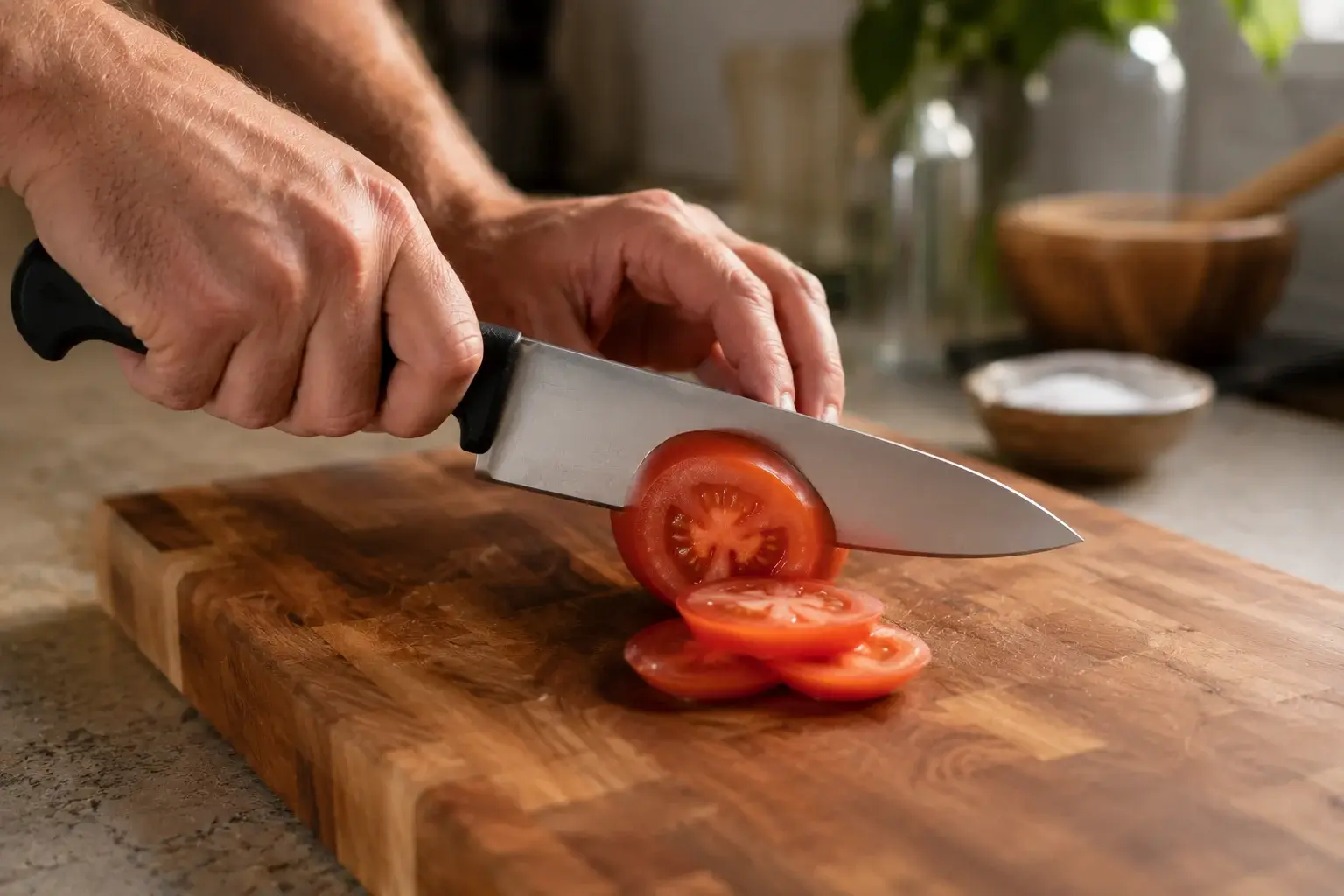
- The Serrated Bread Knife (8 to 10 inches): This has teeth like a saw. It is necessary for cutting through crusty bread or soft tomatoes without squishing them.
If a budget set spends all its manufacturing cost on making just these three blades good, you win. If they split that cost across fifteen pieces, you lose.
Understanding the Steel Without a Science Degree
You do not need to be a metallurgist to buy a good knife, but you do need to understand two basic terms: stamped steel and forged steel.
Forged knives are made from a single piece of hot metal that is hammered into shape. They are thicker, heavier, and have a “bolster” (the thick collar of metal between the blade and the handle). Forged knives are usually expensive. You rarely find a high-quality, fully forged multi-piece set under $100.
Stamped knives are punched out of a flat sheet of metal, like cookie cutters. They are thinner, lighter, and do not have a bolster. For a long time, people thought stamped knives were garbage. But modern manufacturing has changed things. You can now get excellent stamped steel that holds an edge beautifully.
Hardness vs. Brittleness
Cheap steel is soft. It dulls quickly because the sharp edge literally folds over when it hits your cutting board. To fix this, manufacturers add carbon to the steel. High-carbon stainless steel is the sweet spot for beginners. It stays sharp for a reasonable amount of time, and it will not rust if you accidentally leave it in the sink for an hour.
To keep your food safe while prep cooking, you also want materials that are easy to sanitize. Many professional restaurant knives use specific plastics for this exact reason. If you want to know what the pros look for in commercial food equipment materials, you can read the official product certification standards on the NSF website to see how kitchen tools are rated for long-term safety and hygiene.
Realist Breakdown: Top 3 Knife Sets Under $100
I spent hours running numbers, reading the dreaded one-star reviews, and tracking how these budget sets perform after a year on the counter. Here are three sets that actually make sense for a regular kitchen.
| Knife Set | Piece Count | Steel Type | Best For | What My Accounting Brain Noticed |
| Mercer Culinary Millennia 3-Piece Starter Set | 3 Pieces | High-Carbon Japanese Steel | Practical Minimalists | Zero money wasted on filler; every cent went into blade quality. |
| Cuisinart Triple Rivet 15-Piece Block Set | 15 Pieces | High-Carbon Stainless Steel | Families Who Want Steak Knives | The cheapest way to get a full block that doesn’t completely fall apart if you care for it. |
| Henckels Solution 3-Piece Kitchen Set | 3 Pieces | High-Quality German Steel | Brand Lovers on a Budget | Great entry-level steel from a top brand, but the handles feel very light. |
1. Mercer Culinary Millennia 3-Piece Starter Set
This set is the absolute winner for anyone who hates marketing hype. Mercer is a brand that makes knives for culinary schools and commercial kitchens. They do not care about looking pretty on Pinterest. They care about working hard.
This set comes with an 8-inch chef’s knife, a 3.5-inch paring knife, and an 8-inch wavy edge bread knife. No block included. You just get the raw tools.
- The Good: The steel is high-carbon Japanese metal. It takes a very sharp edge and is surprisingly easy to resharpen. The handles are made of a grippy material called Santoprene, which stays safe even if your hands are covered in chicken fat or water.
- The Bad: They look like industrial tools. If your sister is like Paige and wants a beautiful wooden block that matches her kitchen aesthetic, this set will disappoint her. You will also need to buy a magnetic strip or a drawer organizer to store them safely.
2. Cuisinart Triple Rivet 15-Piece Block Set
I usually tell people to run away from 15-piece sets under $100. But I know some people genuinely want a block on their counter and need steak knives for family dinners. If you insist on buying a full block, this Cuisinart set is the only one around eighty dollars that does not make me cringe.
- The Good: Unlike most cheap sets that use flimsy handles glued onto the metal, these have a full tang (the metal runs all the way through the handle) and are held together by three solid rivets. This keeps the handle from snapping off when you apply pressure.
- The Bad: Because they had to make fifteen pieces for a double-digit price, the steel is on the softer side. You will have to use the included honing steel frequently to keep them from getting dull. Also, the kitchen shears that come with it are prone to rusting if you do not dry them instantly.
3. Henckels Solution 3-Piece Kitchen Set
Henckels is a massive name in the knife world. Their high-end German sets cost hundreds of dollars. The “Solution” line is their entry-level stamped series designed to hit the budget market.
- The Good: The blade geometry is excellent. The chef’s knife has a nice curve that makes rocking cuts through herbs and onions very smooth. The German stainless steel is incredibly resistant to rust and stains.
- The Bad: The handles are made of lightweight plastic. They feel a bit hollow in your hand compared to heavier forged knives. If you prefer a knife with some heft to it, this will feel too light.
Why I Read One-Star Reviews First
When I am looking at products on Amazon, I do not care about the five-star reviews written the day the box arrived. I filter straight to the one-star complaints from people who have owned the item for six months.
For cheap knife sets, the complaints always fall into three categories:
- “They started rusting after two weeks.” This happens because people put their knives in the dishwasher. Dishwasher detergent is incredibly harsh, and the high heat will ruin steel. Even the most expensive knives will rust if you do that.
- “The blade chipped when I hit a bone.” Budget knives are not butcher cleavers. If you try to hack through a frozen chicken breast or a beef bone with a thin, stamped chef’s knife, the metal will bend or break.
- “The handle came loose.” This is the hallmark of cheap construction. Look for knives where the blade metal is firmly secured, or where the handle material is molded directly onto the steel without gaps.
How to Make a $20 Knife Feel Like a $100 Knife
You do not need to spend a fortune to have a sharp kitchen. A cheap knife that is properly maintained will always cut better than a three-hundred-dollar Japanese blade that has been beaten up and neglected.
The most important thing you can do is stop using glass or marble cutting boards. Glass does not give when the knife hits it. It acts like a hammer, flattening the sharp microscopic edge of your blade instantly. Use wood, bamboo, or soft plastic instead.
Second, learn the difference between honing and sharpening. Honing is what you do with that steel rod. It does not actually remove metal; it just straightens out the edge of the blade when it gets wavy from use. Sharpening actually grinds away old metal to create a brand-new edge. For budget steel, a quick pass on a honing rod before you cook will keep the knife gliding through food much longer.
FAQ: What Budget Knife Buyers Actually Ask
Should I put my budget knives in the dishwasher if the box says “dishwasher safe”?
Absolutely not. Manufacturers print “dishwasher safe” on the box because it helps sell products to busy people. But the environment inside a dishwasher is a nightmare for steel. The water blasts the knives around, knocking the sharp edges against plastic racks or other silverware.
More importantly, the high heat and wet environment promote rapid oxidation. To understand the basic science of how water and air break down metals, you can read about the chemistry of rust and oxidation on Wikipedia. Hand wash your knives with regular dish soap, dry them with a towel immediately, and put them away. Never let them sit wet.
Is a magnetic knife strip safer than a wooden block?
Yes, for two big reasons. First, wooden blocks are dark, deep slots that trap moisture and kitchen grease. If you put a knife away that is even slightly damp, you are creating a perfect home for mold and bacteria.
Second, every time you slide a knife into a wooden slot, the sharp edge scrapes against the wood, which dulls the blade over time. A magnetic strip keeps your blades dry, clean, and out of contact with surfaces that cause friction.
Can I sharpen cheap knives myself, or will I ruin them?
You can absolutely sharpen them yourself. In fact, budget knives are the perfect place to learn. If you mess up the angle on a twenty-dollar Mercer knife, you have not ruined a family heirloom.
Avoid those cheap pull-through sharpeners with the metal V-notches; they tend to rip chunks of metal off your blade unevenly. Instead, get a simple dual-grit whetstone or a guided sharpening system. It takes ten minutes to learn the basic motion, and it will save you from ever buying a new set just because the old one got dull.
My hands get slippery when I prep food. Which handle material is safest?
Avoid smooth, polished wood or hard, glossy plastic if you worry about your grip. When your hands are wet, those surfaces act like ice. Look for textured synthetic materials.
Materials like Santoprene, textured poly, or rubberized grips are designed to provide friction even when wet. This prevents your hand from slipping forward onto the sharp heel of the blade when you are pushing down on hard foods like carrots or winter squash.
Why does my new knife feel blunt when cutting tomato skins but fine on potatoes?
Tomato skins are glossy, tough, and flexible. A knife edge that is slightly misaligned or rounded will just slide right off a tomato skin instead of biting into it. A potato is hard and offers resistance, which allows even a slightly dull knife to wedge its way through by pure force.
If your knife is failing the tomato test, it means the microscopic edge has folded over. It is time to run it down your honing steel a few times to stand that edge back up straight.
Do I really need a separate bread knife, or can I just use my chef’s knife?
You really need the serrated edge if you cut anything with a hard crust or a soft, delicate interior. A straight-edge chef’s knife relies on a clean wedge action. If you try to push a straight blade through a loaf of sourdough, you will end up crushing the fluffy bread before you cut the crust.
The teeth on a bread knife act like a hand saw, cutting through the tough exterior with minimal downward pressure. It is also the secret weapon for cleanly slicing soft birthday cakes and large watermelons.


