Wood vs plastic cutting board: the hygiene truth?
I am an accountant by training. That means I spend my days staring at spreadsheets, tracking down missing pennies, and hunting for systemic errors. When I bought my first apartment kitchen gear, I applied that exact same logic. I read the official government recommendations, bought a cheap white plastic cutting board, and assumed I was completely safe from food poisoning.
My reasoning was simple: plastic is non-porous. You can throw it right into the dishwasher. Wood is porous, absorbs liquids, and cannot go into a 140°F wash cycle without warping into a skateboard. Therefore, plastic must be cleaner.
But then I actually used the board for six months.
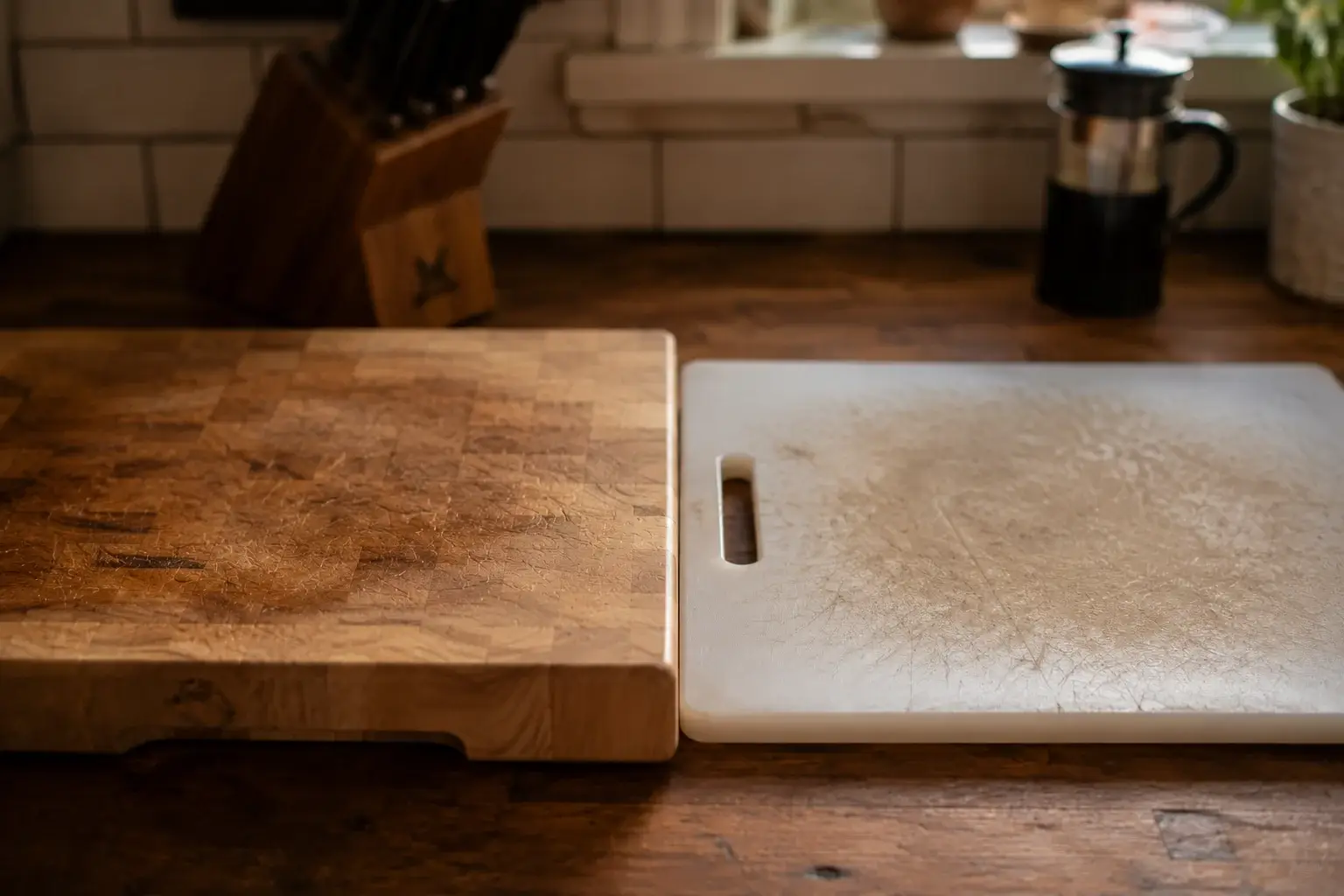
I noticed deep, dark knife scars forming right in the center where I chopped chicken. No matter how much dish soap I scrubbed into those grooves, the stains stayed. My accounting brain started pulling the thread: if soap and water cannot get the stains out of those microscopic plastic canyons, can they actually get the bacteria out?
It turns out the conventional kitchen wisdom is completely backwards. If you look at the actual microbiological data instead of the marketing copy on the back of a plastic board wrapper, the reality of the wood vs plastic cutting board: the hygiene truth debate is eye-opening.
The Accident That Flipped Kitchen Science Upside Down
For decades, every official health organization told home cooks to avoid wood. In the early 1990s, a researcher named Dean Cliver at the University of California, Davis, set out to design a foolproof way for home cooks to sterilize their wooden boards so they wouldn’t get sick. He assumed plastic was already safe and wanted to fix the “dangerous” wood problem.
His team contaminated both new and heavily used wooden and plastic boards with nasty bugs like Salmonella, E. coli, and Listeria. Then they tried to recover the bacteria to see how long they survived.
The results completely shocked the researchers.
On new plastic, the bacteria stayed right on top, waiting to hitch a ride on the next piece of food. On wooden boards, the bacteria sank down into the wood pores within three to ten minutes. Once the bacteria were sucked into the grain via capillary action, they could not be recovered from the surface. They couldn’t multiply, and they gradually died off over a few hours.
Even better, when Cliver tested used wooden boards that were covered in knife scars, they behaved almost exactly like brand-new wood. But when he tested used plastic boards with deep knife gouges? The bacteria lodged themselves inside those thin plastic flaps and refused to come out, even after manual scrubbing with hot water and soap.
This happens because plastic is soft enough to deform under a knife blade. The knife creates a tiny microscopic cave with overhanging plastic edges. When you wash it by hand, the surface tension of the water prevents soap from actually reaching the bottom of that cave. Wood, however, has a natural cellular structure that pulls moisture away from the surface, effectively suffocating the bacteria by robbing them of the water they need to survive.
Breaking Down the Materials: A Side-by-Side Audit
To see how this plays out in a real kitchen, we have to look past the surface level. Here is a breakdown of how these materials actually hold up across hygiene, knife health, and real-world durability.
| Material Feature | Hardwood (Maple, Walnut, Cherry) | High-Density Plastic (HDPE / Polypropylene) | Bamboo |
| Bacterial Surface Retention | Low. Capillary action sucks bacteria inward where they suffocate and die. | High on used surfaces. Micro-grooves shield bacteria from hand washing. | Low. Naturally dense cellular structure resists deep liquid penetration. |
| Dishwasher Compatible | Absolutely not. Will crack, split, and dissolve the food-safe glue lines. | Yes. High heat helps sanitize the deep knife scars that hands can’t reach. | No. The high heat and moisture will split the grass fibers quickly. |
| Knife Friendliness | Excellent. Wood fibers give way under the edge, keeping your knife sharp. | Moderate. Soft enough to cushion the blade, but prone to deep scarring. | Poor. High silica content makes bamboo incredibly hard, dulling knives fast. |
| Microplastic Risk | Zero. You only risk ingesting trace amounts of inert wood cellulose. | High. Every heavy chop sheds microscopic plastic fragments into your food. | Zero. Entirely organic material held together by food-grade resins. |
| Typical Lifespan | 5 to 15 years if oiled; can be sanded down to look brand new. | 1 to 2 years before knife scarring makes it a biohazard. | 2 to 5 years before the glue seams begin to separate from moisture. |
Why Used Plastic Is Secretly Genuinely Gross
Let’s look at the failure modes of plastic. When a plastic board is brand new, it is an excellent material. It is completely flat, non-porous, and easily wiped clean. But nobody keeps a cutting board in a display case.
Every single time your chef’s knife hits that plastic, it slices open a new channel. Over six months of making dinner, you create a microscopic jungle of shredded plastic fuzz. If you cut raw chicken on that board, the chicken juices slip right into those deep channels.
If you do not have a dishwasher that runs a certified sanitizing cycle reaching at least 140°F, hand-washing that scarred plastic board with a standard sponge is mostly security theater. The sponge simply glides right over the top of the plastic flaps, leaving the trapped bacteria and fats perfectly safe underneath.
There is an additional problem that my accounting brain hates: depreciation. You cannot fix a plastic board. Once it is heavily scarred, it is trash. Furthermore, modern environmental science shows that chopping aggressively on plastic boards generates tens of millions of microplastics every year, which stick straight to your chopped onions and garlic.
The Hardwood Defense: How Wood Cleans Itself
Wood feels like it should be the wrong choice because it feels like a sponge. If you pour water on a piece of raw maple, the water sinks in. But wood is not a passive block of dead material; it has an incredibly complex structural design.
Hardwoods used for kitchen gear contain natural organic compounds like tannins, which have mild antimicrobial properties. To verify this, I looked up the historical research on how different wood species react to food pathogens. I skipped the marketing pages for expensive boutique boards and went right to the source. Decades ago, when scientists checked the survival rates of foodborne pathogens on various surfaces, the data published in the Journal of Food Protection showed that wood consistently outperformed plastic in reducing surface bacteria numbers without any heavy chemical intervention.
When bacteria land on a wooden board, the capillary action of the wood grains acts like a vacuum cleaner. It pulls the moisture and the bacteria down into the lower layers of the board. Once inside, the bacteria are trapped. They cannot get back out to contaminate your next vegetable. Because the wood naturally dries out between uses, the bacteria are deprived of oxygen and water, causing them to die off naturally.
[Surface Bacteria] -> [Capillary Action Pulls Fluid In] -> [Bacteria Trapped in Cellulose Matrix] -> [Board Dries Out] -> [Bacteria Die]
This self-cleaning mechanism works beautifully as long as you follow one rule: you must let the board dry completely between uses. If you leave a wooden board soaking in a wet sink for twelve hours, you ruin the system, rot the wood, and create a breeding ground for mold.
What About Bamboo?
Bamboo is often marketed as the eco-friendly, ultra-hygienic alternative to both wood and plastic. It looks like wood, it acts like wood, but it is actually a grass.
From a pure hygiene standpoint, bamboo is highly effective. It has an incredibly dense cellular structure, which means it absorbs very little water and resists deep knife gouges better than soft woods. To confirm how health officials view alternative materials, I checked the USDA’s official safe food handling guidelines for cutting surfaces, which explicitly highlight bamboo as a highly non-porous option that naturally resists deep knife scarring.
But there is a major catch that made me stop using my bamboo board entirely: it absolutely ruins your knives.
Because bamboo is a grass, its cell walls are packed with microscopic silica crystals. Silica is essentially nature’s glass. Every time your steel knife edge strikes a bamboo board, it is hitting tiny rock-hard particles. A knife that stays razor-sharp for a month on a maple board will turn as dull as a butter knife in a week on bamboo.
Additionally, bamboo boards are not made from a single solid piece of material. They are constructed by gluing hundreds of tiny strips of bamboo together under immense pressure. That means your food is constantly touching large amounts of industrial wood glue. If you buy a cheap, unbranded bamboo board from an online marketplace, you have no idea if that glue is stable under heat or if it contains questionable chemicals.
How to Set Up a Foolproof Home Kitchen System
You do not need to buy a $300 custom walnut chopping block to keep your kitchen safe. My sister Paige is always sending me photos of gorgeous, massive end-grain blocks that look like art pieces. They look great on Pinterest, but they are heavy, hard to clean in a small apartment sink, and unnecessary for basic safety.
Instead, I recommend a simple two-board system that keeps cross-contamination impossible while protecting your knives and your budget.
Board 1: The Heavy Hardwood Block (For Everything Except Raw Meat)
Buy one good, thick piece of solid edge-grain maple or walnut. It should be at least 1.5 inches thick so it won’t warp. Use this board for your vegetables, fruit, bread, cheese, and cooked meats. This is the board that stays on your counter, protects your knife edges, and lasts for a decade.
I use a standard 18×12-inch maple board from John Boos. It isn’t cheap, but when you look at the amortization schedule over ten years, it costs pennies per month compared to buying a new plastic board every year.
Board 2: The Utility Plastic Board (For Raw Meat and Poultry Only)
Buy a high-quality, high-density polyethylene (HDPE) plastic board. Keep it thin and light. Use it exclusively for raw chicken, pork, and beef. The moment you are done slicing your meat, pick up the board and put it directly into the dishwasher.
Do not wash it by hand. Let the 140°F+ water and harsh detergents of the machine do the heavy sterilization work that your hand sponge cannot manage. The moment this plastic board starts looking fuzzy or heavily gouged, throw it in the recycling bin and buy another one. I use a simple OXO Good Grips utility board with non-slip edges for this exact purpose because it fits easily into a standard dishwasher rack.
The Realist’s Guide to Cleaning and Maintenance
If you treat a wooden cutting board like a standard non-stick frying pan, you will destroy it within a week. My first wooden board split cleanly in half because I left it sitting in a puddle of soapy water at the bottom of my sink overnight. It was an expensive lesson in wood anatomy.
The Daily Wash Routine
When you are done using your wooden board, scrape off any loose food bits. Wash it under warm running water with a tiny drop of mild dish soap and a clean brush. Do not submerge it. Rinse it immediately, wipe off the standing water with a clean towel, and prop it up vertically on its edge.
Never dry a board flat on your counter. Moisture will get trapped underneath, causing the bottom side to dry slower than the top side. This uneven drying rate creates internal tension in the wood grain, which causes the board to cup and warp.
The Monthly Oiling Schedule
Wood needs oil to maintain its water resistance. If the wood dries out completely, it will begin to absorb water too deeply, which leads to structural cracking. Once a month, when the board looks dry and pale, rub it down with a generous amount of food-grade mineral oil.
Do not use vegetable oil, olive oil, or canola oil from your pantry. Those are unsaturated fats that will oxidize over time, go completely rancid, and make your entire board smell like old paint. Food-grade mineral oil is a completely stable, shelf-safe product that costs about five dollars a bottle at any pharmacy.
To ensure your cleaning steps match verified public health standards, you can review the full safe sanitation methods provided by the Penn State Extension service, which details exactly how to dry and store boards to prevent microbial growth.
Authentic Cutting Board Hygiene FAQ
Can I use vinegar to safely sanitize a wooden cutting board?
Vinegar is a wonderful cleaning agent for breaking down mineral deposits and neutralizing basic kitchen odors, but it is not a registered hospital-grade sanitizer. It will kill some weak household bacteria, but it will not reliably knock out heavy foodborne pathogens like Salmonella if the board was heavily cross-contaminated by raw poultry juices. Stick to hot, soapy water for daily maintenance, and use a mild bleach solution if you need to perform a serious deep clean after a mishap.
What should I do if my wooden board starts to smell like onions?
The accounting brain hates buying single-use deodorizing sprays when you already have the solution in your pantry. Sprinkle a heavy layer of coarse kosher salt across the surface of the dry board. Cut a fresh lemon in half, press it cut-side down onto the salt, and scrub the board vigorously using the lemon like a sponge. The citric acid binds with volatile odor compounds while the salt acts as a mechanical abrasive to lift trapped food particles out of the surface grain. Rinse with warm water and let it dry completely on its edge.
Is it safe to use a microwave to sanitize a small wooden cutting board?
While early lab research proved that running a small, metal-free wooden block through a microwave oven can kill deep-seated bacteria via internal heating, I highly advise against doing this at home. Wood contains natural pockets of structural moisture. Heating those water molecules rapidly inside a microwave creates intense localized steam pressure. This steam expands violently within the wood grain, which can cause the board to literally explode or split down the center without warning. Stick to manual surface sanitation.
How do I know when my plastic cutting board is too dangerous to keep using?
Run your fingernail flat across the center of your plastic board. If your nail catches on deep, furry plastic ruts, or if the center of the board looks permanently stained and dark even after a run through a hot dishwasher cycle, its lifespan is officially over. Those deep grooves indicate that the plastic has delaminated, creating microscopic caves that protect bacteria from standard cleaning. Throw it out and spend ten dollars on a fresh replacement utility board.
Does the type of wood matter when it comes to cutting board safety?
Yes, the species of wood dictates both its safety profile and its longevity. You must only use tight-grained hardwoods with closed pores, such as sugar maple, walnut, or black cherry. Avoid open-pored hardwoods like red oak or ash. If you look at oak under a microscope, its pores look like wide, open drinking straws. Those massive channels will suck in large amounts of meat juices and food fats that are incredibly difficult to clean out, eventually causing the board to rot from the inside out.
Why do some chefs recommend end-grain boards over edge-grain boards?
End-grain boards are built with the wood fibers standing vertically, like a bundle of matchsticks. When your knife strikes the board, the blade slips between the vertical fibers rather than cutting across them. This makes end-grain boards exceptionally gentle on knife edges and allows the wood to “self-heal” as the fibers slide back into place. However, they are significantly more expensive to manufacture, require much more frequent oiling, and absorb liquids faster than edge-grain boards, making them less practical for a budget-conscious beginner kitchen.
Is it legal to use wooden cutting boards in commercial restaurant kitchens?
This is an incredibly common kitchen myth. To understand the legal reality of food service inspections, I went directly to the FDA’s current Food Code documentation regarding cleanable food-contact surfaces, which explicitly permits the use of hard maple or similar tight-grained hardwoods for cutting blocks and baker’s tables in commercial establishments. Restaurants often use color-coded plastic boards simply because they can be stacked by the dozens and thrown into giant commercial flight-type dishwashers, not because wood is illegal or inherently unsafe.