What is a paring knife used for? Do You Need One?
Let’s be completely honest. If you bought one of those giant, 15-piece wood knife blocks because it was on sale, you probably have a tiny little knife sitting at the very bottom. It has a short blade, usually about three or four inches long.
If your kitchen history looks anything like mine did in my first apartment, you mostly use that tiny knife to rip open stubborn plastic delivery boxes or slice an occasional lemon for a drink. Back then, I didn’t know a thing about proper kitchen tools. I burned rice, I overcooked canned soup, and I thought a small knife was just for people who were scared of the big chef knife.
But as I started spending weeks building spreadsheets to analyze kitchen gear before spending my hard-earned cash, I learned that this little tool actually has a specific job. You do not need to be a fancy chef to use one. You just need to know what it does well and when you should leave it in the drawer.
Let’s look at what this tool is really for, how it works, and if you actually need to spend money on one.
What Exactly Is a Paring Knife?
A paring knife is basically a mini version of a chef knife. The blade is very short, usually between 2.5 and 4 inches long.
The word “pare” means to cut off the outer skin or outer layer of something. That tells you everything you need to know about its main design. It is made for small, detailed tasks where a big, heavy knife would feel like trying to write a grocery list with a giant permanent marker.
The biggest difference between this tool and other kitchen knives is how you hold it. With a big chef knife, you always work against a heavy cutting board on your counter. With a small blade, you often lift the food into the air and cut toward yourself or slice right in your hand.
What Is a Paring Knife Used For? The Real Jobs
You do not need to make fancy vegetable roses to get your money’s worth out of this tool. In a normal home kitchen, it excels at three main types of work.
1. Peeling Skins and Cores
If you need to peel an apple, a pear, or a potato, this tool works like a charm. Because the blade is so short, your thumb can rest right on the fruit to guide the edge. This gives you tons of control so you only remove the paper-thin skin, not the actual food underneath. It is also perfect for cutting the cores out of apples or strawberries.
2. Detailed Slicing and Mincing
Have you ever tried to trim the fat off a small chicken breast or cut the bad spots out of a potato with an 8-inch chef knife? It feels clumsy and unsafe. The little blade lets you get into tiny spaces easily. It is also excellent for slicing garlic cloves thin or cutting small shallots.
3. Cleaning and Prepping Veggies
This is the tool you want when you need to scrape the strings off celery, de-vein shrimp, or cut the tops off green beans. It is lightweight, quick to grab, and doesn’t tire out your hand.
The Four Main Types of Paring Knives
Not all of these little blades look the same. If you look at options online, you will see a few distinct shapes. My accounting brain likes to break these down by their specific return on investment, because some shapes are highly useful while others are way too specific for a regular home.
The Spear Point (The Regular One)
This is the classic shape you see everywhere. The blade has a slight curve along the edge that leads to a sharp point. If you only buy one, make it this one. It can peel, slice on a board, and poke out potato eyes without any trouble.
The Bird’s Beak (The Curved One)
This blade curves downward, looking exactly like a bird’s beak. To understand its design history, you can read about the history of classical French cuisine cutting styles on Wikipedia where this shape was created to make uniform, seven-sided curved vegetables. Unless you are planning to attend culinary school, you can skip this one completely. It is terrible for cutting on a flat board.
The Sheep’s Foot (The Flat One)
This blade is perfectly flat along the sharp edge, and the back spine curves down to meet it. It is amazing for slicing small items against a board because the whole edge touches the wood at once. It is not as good for peeling round fruits, though.
The Serrated One
This one has tiny teeth like a bread knife. It is decent for slicing small, slippery things like cherry tomatoes or slick plums, but it is hard to sharpen at home.
Paring Knife vs. Chef Knife: The Differences
To get a clear picture of why you would use one over the other, let’s look at how they stack up side by side.
| Feature | The Small Paring Blade | The Big Chef Knife |
| Blade Length | 2.5 to 4 inches | 8 to 10 inches |
| Main Workspace | Up in the air (in your hand) | Flat on a heavy cutting board |
| Best Food Sizes | Small (Garlic, berries, limes) | Large (Onions, melons, potatoes) |
| Cutting Action | Peeling, picking, light slicing | Rocking, chopping, dicing |
| Safety Level | High for small detail items | High for heavy, hard vegetables |
Whenever I am deciding which one to grab, I use a simple rule of thumb: if the food is smaller than my fist, I consider the small blade. If it is bigger, the chef knife wins every single time. Trying to cut a hard sweet potato with a tiny blade is a fast way to slip and end up needing a doctor.
Do You Actually Need to Buy One?
Here is my honest, non-hype opinion: Yes, but you only need one, and you shouldn’t spend a fortune on it.
You will see high-end knife brands trying to sell gorgeous, forged German steel little knives for $80 or more. Don’t fall for the trap. As someone who spends hours scanning one-star reviews to find where products fail, I can tell you that expensive small knives usually break or lose their edge just like the cheap ones if they get tossed into a crowded utensil drawer.
My sister Paige always argues that we should buy the prettiest, most matching set for the kitchen counter aesthetic. But from a pure utility standpoint, a simple, cheap knife with a plastic handle does the exact same job.
Brands like Victorinox make a classic small blade with a textured plastic handle that costs less than a fast-food lunch. It stays sharp, it is lightweight, and if you accidentally drop it in the trash can while peeling potatoes, your budget isn’t ruined.
How to Care for Your Small Knives
If you want your tools to last without rusting or getting dull, you have to treat them right. I learned this the hard way after ruining my first decent set by treating them like regular forks.
- Keep them out of the dishwasher: The high heat and harsh soap will dull the sharp edge and ruin wooden handles. Wash them by hand with warm water and normal dish soap.
- Dry them immediately: Leaving a wet knife to air-dry in a rack is how you get tiny rust spots. Wipe it dry with a towel right after washing.
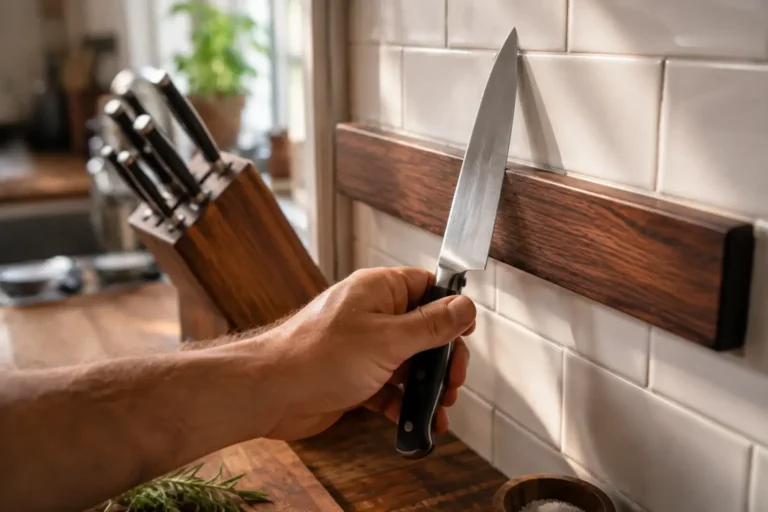
- Store them safely: Do not throw them loose into a drawer. The blades will bang against other metal spoons and get nicked. Use a simple magnetic strip, a knife block, or a cheap plastic blade cover.
Common Questions People Ask (FAQ)
Can I use a paring knife to chop an onion?
You can use it for a small shallot or a tiny onion if you are careful, but it is not the right tool for a standard medium or large onion. Because the blade is so short, it won’t slice all the way through the vegetable in one clean motion. You end up having to hack at it from multiple angles, which leads to uneven pieces and a higher risk of the blade slipping off the slick layers. Stick to your chef knife for standard onions.
Is a utility knife the same thing?
No, a utility knife is slightly larger. It usually fills the gap between the small three-inch blade and the big eight-inch chef knife, coming in around five or six inches long. A utility knife is great for slicing sandwiches or small blocks of cheese, but it is a bit too long and clumsy to hold comfortably in the air for peeling a round apple skin.
Why do some small knives have plastic handles?
Many commercial kitchens and home cooks actually prefer high-quality plastic handles (like those made from polypropylene) because they are highly sanitary, easy to grip when wet, and very affordable. They also don’t crack or warp if they accidentally sit in a puddle of water on the counter for twenty minutes, unlike fancy wood handles.
How often do I need to sharpen a small knife?
Because these knives carry a very thin, delicate edge, they can dull quickly if you use them on hard plastic cutting boards. If you use it a few times a week, you should run it across a simple sharpener or ceramic rod every few months. A dull knife requires you to push harder, which is exactly how accidents happen in the kitchen.