Chef knife vs santoku: which is right for you?
If you are looking at your kitchen drawer right now, staring at a dull, lightweight knife that came from a discount department store college pack, you already know you need an upgrade. You want one good knife that cuts an onion without making you weep, handles a tough sweet potato without getting stuck halfway through, and does not require a culinary degree to keep sharp.
But when you open an online shop or walk into a store, you run straight into a wall of marketing terms. You see long, heavy blades with a distinct curve, and you see shorter, flatter blades with little dimples on the side.
One is a classic Western chef knife. The other is a Japanese santoku.
When my sister Paige started building out the look for our site, she sent me a text with links to three different aesthetic knife sets, asking if she should pin them. My response was a long message explaining why buying a massive 15-piece block set is the fastest way to waste a hundred bucks. You do not need a specialized blade for every individual vegetable. You need one reliable tool that fits your hand, fits your budget, and handles 90 percent of your daily prep work.
Choosing between a chef knife and a santoku comes down to how your hands move, how much space you have, and what you actually cook on an ordinary Tuesday night. We are going to look past the marketing claims and look at the actual geometry, weight, and real-world failure modes of both designs so you can buy exactly what you need.
Anatomy of the Blades: Rocking vs. Pushing
The single biggest difference between these two tools is not where they are made or what kind of wood is in the handle. It comes down to the shape of the cutting edge, which dictates the exact mechanics of how you prep food.
The Western Chef Knife Profile
A standard Western chef knife features a long, heavy blade that usually ranges from 8 to 10 inches. The defining characteristic is the pronounced curve along the bottom edge, often called the “belly” of the blade.
This curve exists for one specific reason: it allows for a continuous rocking motion. When you chop herbs or dice a carrot, the tip of the knife never actually leaves the cutting board. You lift the heel, slide the food underneath, and rock the blade forward and down.
Because of its length and weight, a chef knife acts like a lever. The extra mass at the heel gives you natural leverage when you need to cut through thick, dense items. If you are regularly splitting acorn squash or cutting up a whole chicken, the thickness of a Western blade provides the structural support needed to handle that resistance without flexing.
The Santoku Profile
The word santoku comes from the Japanese term santoku bōchō, which translates literally to “three virtues” or “three uses.” According to the historical design records tracked on the general history of the santoku design on Wikipedia, the blade was created in mid-20th-century Japan as a household generalist tool. It combined the features of a traditional vegetable cleaver (nakiri) and a meat knife (gyuto) so everyday home cooks could handle meat, fish, and vegetables with a single tool.
A santoku is generally shorter than a chef knife, usually measuring between 5 and 7 inches. The edge is remarkably flat, and the spine curves down sharply at the end to meet the edge, creating what is known as a sheep’s foot tip.
Because the edge is flat, you cannot rock a santoku. If you try to rock it, the knife simply clunks against the board and stops. Instead, you use a distinct up-and-down “push cut.” You bring the blade down and slightly forward in a single, clean stroke. The entire edge hits the cutting board at the exact same moment.
Edge Geometry and the Physics of Sticking
When you look at the thickness of the metal itself, you find the second major functional split between these two styles. The differences in edge angles change how the knife feels inside the food.
Blade Thickness and Bevel Angles
Western chef knives are built for durability. The steel is slightly softer but more forgiving, and the blade is ground to an angle of roughly 15 to 20 degrees on each side. The spine is thick, tapering down to a sturdy wedge. This design ensures that if you accidentally hit a stray bone or drop the knife on a hard floor, the edge is more likely to dull or roll slightly rather than shatter.
A traditional santoku uses a much harder, thinner steel. The edge is ground to a much sharper angle, typically between 12 and 15 degrees.
Think of a chef knife as an axe and a santoku as a razor blade. The thinner profile of the santoku means it experiences far less physical resistance when moving through food. When you slice through a crisp radish or a cold carrot, it glides through the cells cleanly.
The Granton Edge Mystery
You have probably noticed that many santoku blades feature a row of small, oval dimples along the side. This is officially called a Granton edge. The marketing copy on almost every retail site will tell you these dimples create small air pockets that completely prevent food from sticking to the metal.
Let’s look at that claim through a realistic lens. If you are slicing paper-thin sheets of cucumber or damp potato rounds, the dimples do help break the vacuum seal, allowing the slices to drop off rather than riding up the blade. But if you are chopping a thick onion or an apple, the food is wider than the dimples anyway, and it will stick regardless of the pattern on the steel. Do not buy a knife purely because it has these dimples. They are a minor convenience for specific vegetables, not a magical solution to kitchen friction.
Head-to-Head Comparison
To see how these differences play out when you are actually standing over a cutting board at 6:00 PM trying to get dinner ready, let’s look at the specifications side by side.
| Feature | Western Chef Knife | Japanese Santoku |
| Average Blade Length | 8 to 10 inches | 5 to 7 inches |
| Edge Shape | Noticeably curved (swept belly) | Visibly flat (straight edge) |
| Cutting Motion | Rocking heel-to-tip | Vertical up-and-down push |
| Edge Angle | 15 to 20 degrees per side | 12 to 15 degrees per side |
| Spine Thickness | Thicker, acts like a wedge | Thinner, minimal wedging |
| Weight | Moderate to heavy | Exceptionally light |
| Best For | Dense root vegetables, bone-in meat, bulk mincing | Precision slicing, fine dicing, small kitchens |
Real-World Testing: The Vegetable and Meat Breakdown
To understand how these tools behave, it helps to look at how they manage common, repetitive prep tasks. This is where the physical weight and length matter far more than the brand name.
Dicing Onions and Soft Produce
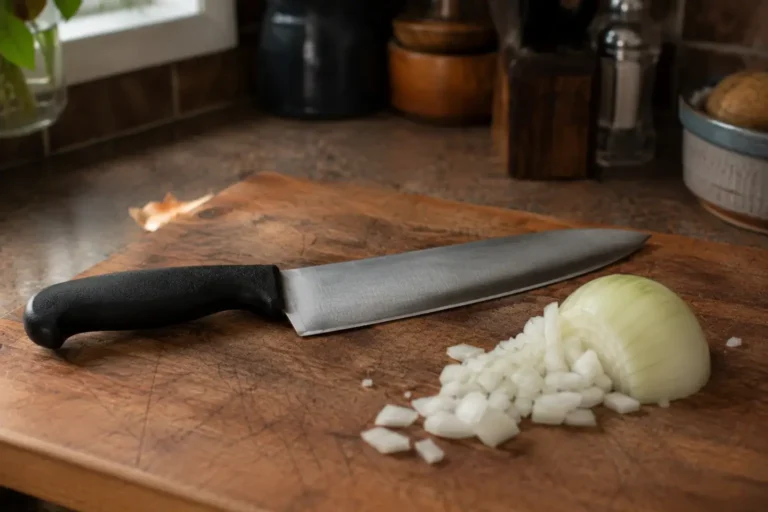
When you dice a standard yellow onion, you make a series of horizontal and vertical cuts before slicing across the bulb.
A chef knife uses its pointed, sharp tip to glide through these internal layers cleanly. The extra length means you can make long, sweeping strokes. If you prefer the classic rocking motion, you can zip through an entire pile of onions quickly without ever lifting the front of the knife from the board.
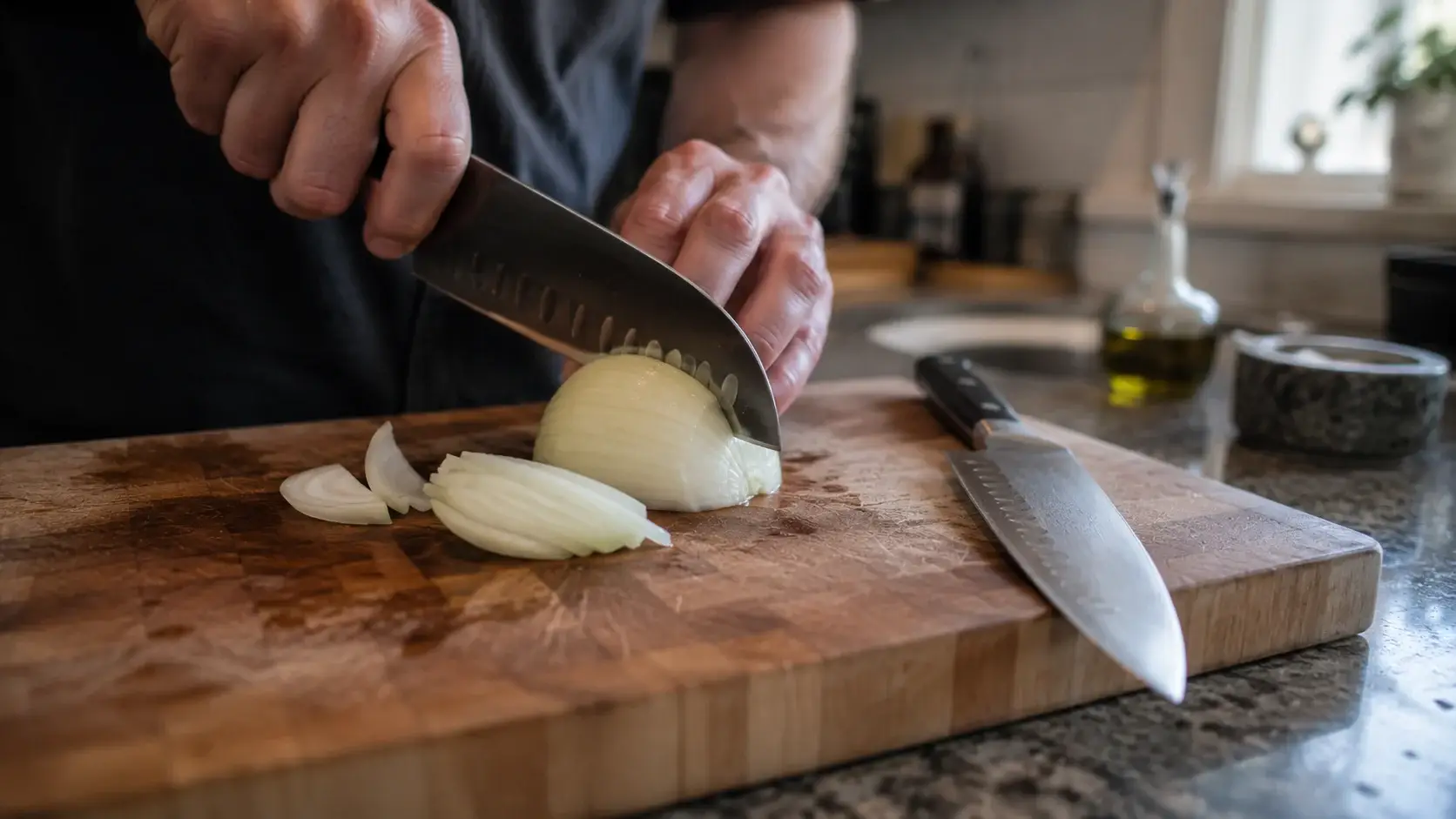
A santoku approaches the onion differently. Because the blade is shorter and the tip curves down, you use the front section of the flat edge to score the vegetable. The push-cut style means you press straight down through the onion. Because the blade is thin, it rarely wedges or cracks the onion layers apart prematurely. Furthermore, the wide, flat face of a santoku makes it an exceptional scoop. You can slide the blade flat underneath the entire pile of diced onions to carry them over to your hot pan without dropping half of them on the floor.
Hard Root Vegetables and Light Butchery
This is the specific scenario where the accounting brain favors the heavy Western design. If you have ever tried to cut a large butternut squash or a raw sweet potato in half with a small, lightweight knife, you know the terrifying feeling of the blade getting stuck solid in the middle of the vegetable.
A standard 8-inch chef knife has the physical mass needed to drive through dense starch. The thicker spine pushes the vegetable halves apart like a wedge as it descends.
Additionally, if you buy chicken breasts with the bone still in because they are cheaper per pound, a Western knife can handle the occasional scrape against a rib bone without taking damage. The steel is tough enough to take a beating.
If you try to force a thin, hard Japanese santoku through that same raw butternut squash or press it against a chicken bone, you run a real risk of chipping the edge. The steel used in high-quality santokus is intentionally hardened to hold a fine angle, but hard steel is inherently more brittle. If it hits a hard bone or twists sideways inside a dense root vegetable, microscopic pieces of the edge can literally snap off, leaving you with a jagged, ruined tool.
How Hand Size and Kitchen Space Change the Math
We cannot talk about tools without talking about the space they operate in. When I lived in my first small apartment, my kitchen counter space was about the size of a standard piece of printer paper. If I set down a massive 10-inch chef knife, I barely had room left for the cutting board itself.
The Spatial Reality
An 8- or 10-inch chef knife requires physical runway. You need a large cutting board to utilize the full rocking motion effectively. If your board is small, the tip of your knife will constantly hang off the top edge, or the heel will bump into the wall behind your counter.
Because a santoku maxes out around 7 inches, it operates beautifully in tight quarters. You do not need a massive workspace because your cutting motion is entirely vertical. You are not swinging a long arc; you are lifting the blade up and down within a small, controlled footprint.
Comfort and Muscle Fatigue
The physical weight of the tool alters how tired your arm gets during a long prep session. For individuals with smaller hands or lighter wrist strength, a heavy Western knife can feel clumsy, like trying to write a letter with a heavy log. The balance point on a chef knife is often forward of the handle, making the front feel heavy.
A santoku is balanced closer to the middle, right where the handle meets the steel. The lightweight construction means your forearm muscles do not have to work nearly as hard to keep the blade stable. To understand the relationship between blade upkeep and the actual physical strain on your hand, it helps to review professional ergonomics data. For instance, the safety testing protocols published on the equipment evaluation and biomechanics testing pages of Consumer Reports show that clean, sharp, properly balanced cutlery can reduce the required grip force by over 20 percent during repetitive kitchen tasks. If you feel like you are wrestling your knife instead of using it, switching to a shorter, lighter tool changes the entire experience.
Maintenance and the Reality of the One-Star Reviews
Every knife is perfectly sharp the day you take it out of the box. The real test is what happens six months later when it has been banged against a cutting board thousands of times and accidentally left damp in the sink overnight.
Sharpening Angles and Upkeep
Because a chef knife has a wider 20-degree angle, the edge is thick and resilient. You can maintain it easily between uses by running it along a standard steel honing rod. Honing does not remove metal; it simply straightens out the tiny microscopic folds that happen when the edge hits your cutting board. When it finally goes dull, it is very forgiving to sharpen on a standard electric sharpener or a basic manual pull-through tool.
A santoku requires a gentler touch. You cannot take a delicate 12-degree Japanese edge and run it through a cheap, aggressive pull-through sharpener designed for heavy Western tools. Doing so will tear the hard steel and ruin the profile. To keep a santoku performing correctly, you need to learn how to use a basic whetstone, or you must purchase a sharpener that explicitly states it features a dedicated setting for Japanese angles.
Reading the Failure Modes
When you look at the real complaints people post online about these tools, a clear pattern emerges.
The one-star reviews for cheap chef knives almost always complain about the blade losing its edge within two weeks, or the handle loosening up where the plastic meets the steel. Those are structural signs of cheap manufacturing.
The one-star reviews for santokus, however, frequently feature photos of blades with distinct, semi-circular chips missing from the center of the edge. The text usually says something like: “I was only cutting a frozen corn cob and the blade snapped!”
This is not necessarily a defect in the manufacturing; it is a fundamental misunderstanding of the material. Hard, thin steel cannot handle lateral twisting or solid impacts against frozen foods, pits, or bones. If you want a tool you can throw carelessly into a drawer or use to hack through semi-frozen meat, the santoku is not the tool for you.
How to Choose the Right Tool Natively
If you are only going to buy one single knife to handle your kitchen work, you want to buy for your actual daily habits, not an idealized version of cooking.
Buy a Western Chef Knife If:
- You naturally prefer a smooth, sweeping rocking motion when you cut.
- You cook a lot of heavy, dense foods like squash, turnips, potatoes, or bone-in proteins.
- You want a durable, forgiving tool that can handle a bit of rough treatment without chipping.
- You have a large kitchen counter and a substantial wood or plastic cutting board.
If this sounds like your kitchen, a great option to look at is the Victorinox Fibrox 8-Inch Chef’s Knife. It features a slip-resistant handle that stays secure even when your hands are wet with chicken juice, and the Swiss stamped steel is incredibly easy to sharpen at home. It is a no-nonsense choice built entirely for utility.
Buy a Santoku If:
- You prefer an accurate, straight down up-and-down chopping motion.
- Your diet consists mostly of fresh vegetables, soft fruits, garlic, herbs, and boneless chicken or fish.
- You have small-to-medium hands and find long, heavy blades intimidating or fatiguing.
- You live in an apartment with limited counter space and use a compact cutting board.
For this style, the OXO Good Grips 6.5-Inch Santoku Knife is an excellent entry point. It has an incredibly comfortable, cushioned handle that eases wrist pressure, and the shorter blade length gives you total control over the tip when you are doing fine work like mincing garlic or slicing ginger.
FAQ: Deep Answers to Real Buyer Questions
Can I use a santoku knife to cut through meat bones?
Absolutely not. You should never use a santoku to cut through bones, joints, or frozen food items. The steel used in a santoku is hardened to a high level so it can maintain its sharp 12-to-15-degree angle. While hard steel stays sharp longer, it becomes brittle. If the fine edge hits a dense bone, it cannot flex or roll like a softer Western knife would. Instead, the pressure will cause the steel to crack, leaving a permanent chip in your blade. For bone-in butchery, stick to a heavy Western chef knife or a dedicated cleaver.
Why do vegetables stick to my chef knife more than a santoku?
Sticking happens because of a vacuum seal created between the flat surface of the damp vegetable and the wide, smooth face of the steel blade. A Western chef knife has a smooth, continuous taper, which gives the vegetable a large surface area to cling to. Many santoku knives feature small, stamped indentations along the bottom half of the blade. These dimples introduce air between the cut food and the metal, breaking the suction. This allows thin slices of food like cucumbers, zucchini, and raw potatoes to fall away cleanly instead of sliding up the knife face.
Do I need to buy a specific type of cutting board for these knives?
Yes, the material of your cutting board directly affects how long your edge stays sharp. Because a santoku uses a hard, fine edge that strikes the board completely flat with every stroke, you must avoid hard surfaces like glass, granite, or bamboo. Bamboo contains high levels of silica, which acts like a micro-abrasive and will dull your edge quickly. Instead, look for a high-quality wood board or a soft, food-grade plastic option. To check if a specific plastic meets national safety and hygiene requirements for food contact, you can consult the official product certification registry of the NSF to verify the material standard before buying.
How often do I actually need to sharpen a Japanese santoku?
For an average home cook using the tool daily for standard dinner prep, a high-quality santoku will hold its fine edge for roughly three to six months before needing a true sharpening session on a whetstone. However, you should use a ceramic honing rod every few weeks to keep the tip perfectly aligned. Because the steel is harder than a standard Western blade, it requires less frequent sharpening overall, but the process takes a bit more care when you finally do it.
Is an 8-inch knife too big for a beginner home cook?
It depends entirely on your hand size and your physical comfort level. Many people see an 8-inch chef knife in a store and feel like it resembles a sword more than a kitchen tool. If holding the knife makes you nervous, you will naturally tense up your arm, leading to sloppy cuts and sore wrists. A 7-inch santoku or a shorter 6-inch chef knife offers a much lower center of gravity, bringing your hand closer to the food. This proximity gives you a more direct feeling of control, which is why many beginners feel instantly more confident when switching to a shorter profile.
Can I wash either of these knives in the dishwasher?
You should never put a quality kitchen knife in the dishwasher, regardless of whether it is a chef knife or a santoku. The high heat, prolonged moisture, and harsh detergents will dull the cutting edge through microscopic corrosion. More importantly, the high-pressure water jets will cause the blade to rattle against plastic racks or other utensils inside the machine, leading to nicks and chips in the steel. Always wash your knife by hand with warm water and mild soap immediately after use, dry it thoroughly with a towel, and store it safely in a block or a protective sheath.