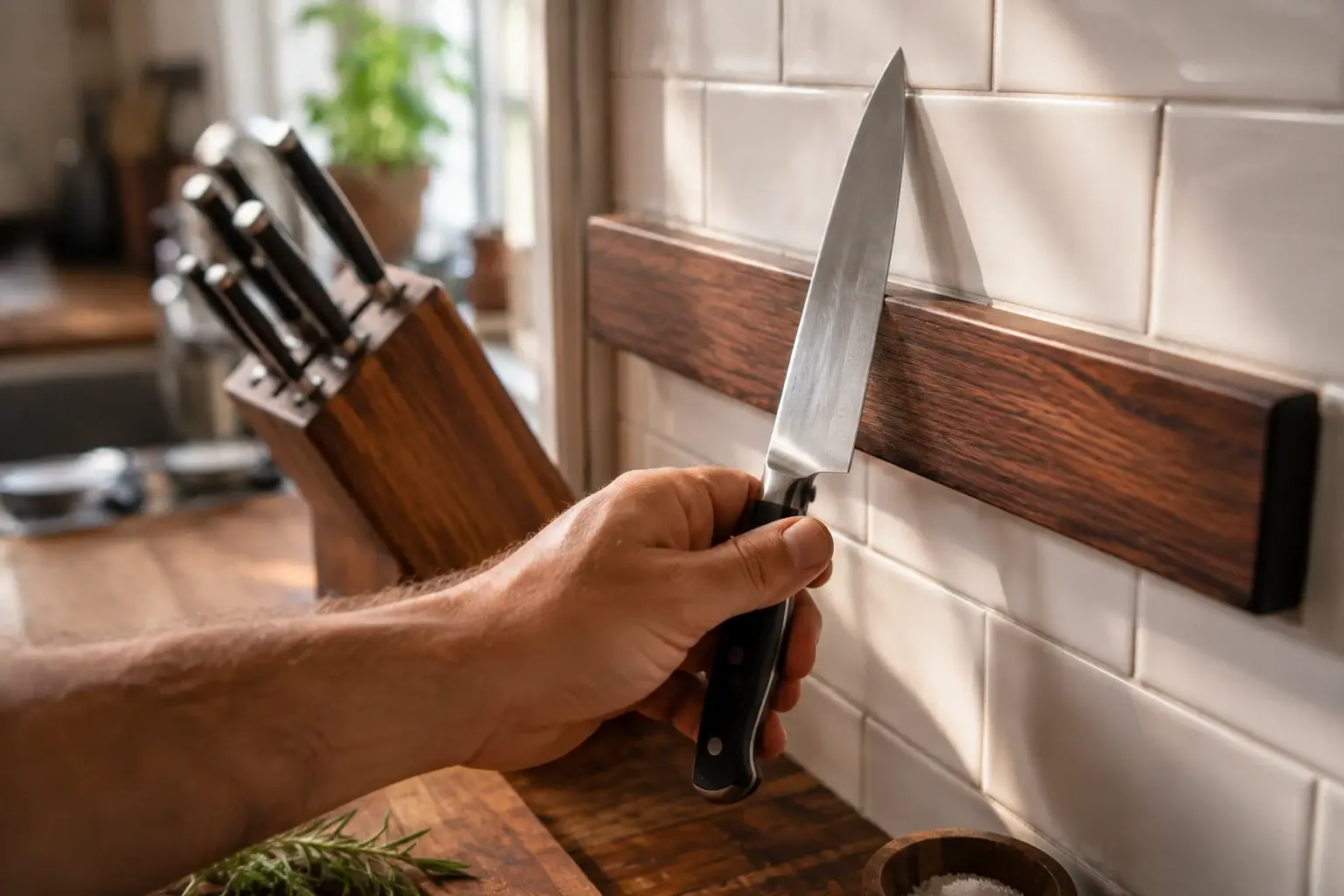
Magnetic Knife Strip vs Knife Block: Which is Safer?
I built a spreadsheet last week before buying a new kitchen trash can. It had columns for plastic thickness, pedal hinge durability, and the exact cost per gallon of capacity. My sister Paige thinks this is a mild form of illness. I call it survival. When you run an accounting desk by day and cook in a standard apartment kitchen by night, you notice when things are built to fail or designed to trick you.
That brings us to knives. Specifically, how we store them.
If you bought a decent knife set at any point in the last thirty years, it probably came shoved inside a heavy chunk of slanted wood. It sits on your counter, takes up space where your cutting board should be, and looks traditional. But lately, everyone on social media is mounting their blades to magnetic wall strips.
Paige wants me to get the wall strip because it gets things off the counter and looks clean for her Pinterest photos. But I don’t care about the aesthetic. I care about whether a heavy, razor-sharp French chef’s knife is going to slip off a wall magnet and drop onto my foot, or if the classic wooden block is secretly ruining my blades.
When you look up magnetic knife strip vs knife block, you get a lot of design advice from lifestyle bloggers. Let’s look at the actual safety data, the bacterial hidden costs, and how these two methods impact your wallet and your fingers.
The Safety Breakdown: Wall Drops vs. Counter Accidents
The number one reason people hesitate to buy a magnetic strip is simple: fear. It feels wrong to hang a row of naked blades on a wall held up by nothing but invisible physics.
I had this exact fear. My first apartment kitchen was tiny, cramped, and I routinely bumped into things. The idea of a 10-inch blade hanging loose at chest height felt like a home accident waiting to happen.
But when you look at how accidents actually happen with a knife block, the script flips completely.
The Invisible Hazard of the Slanted Block
With a traditional block, you are reaching toward a cluster of hidden blades. You can see the handles, but you cannot see the edge. If you are rushing to grab a paring knife to slice an apple, and your hand slips, you are shoving your fingers directly into the path of the other exposed handles and blade heels.
Even worse, blocks sit at counter height. If you have kids, a heavy wooden block is a major leverage hazard. A toddler cannot reach a wall strip mounted five feet high. They can, however, grab the handle of a heavy bread knife sticking out of a block at the edge of a counter and pull the whole top-heavy wooden mass down onto themselves.
How Magnetic Strips Handle the Gravity Problem
A high-quality magnetic strip does not drop knives on its own. The physics of rare-earth magnets (usually neodymium) mean the hold is incredibly binary: it is either completely locked on, or you are actively pulling it off.
The real risk with a wall strip is user error during the grab. If you pull a knife straight off the bar toward you, the tip can pivot and twist out of your hand.
The Proper Pull Technique: Never yank a knife straight off a magnet. Instead, hold the handle and twist the spine of the knife away from the wall first, lifting the sharp edge off the bar like a hinge. This breaks the magnetic seal safely without any sudden snapping or slipping.
The Hygiene Factor: What Is Growing Inside Your Countertop Block?
This is where my accounting brain kicked in and I started looking up public health data. We wash our knives with hot soapy water, slide them into the dark wooden slots of our blocks, and assume they are clean. They are not.
In a comprehensive household germ study conducted by NSF International (an independent public health and safety testing group), researchers tracked where the highest concentrations of mold, yeast, and fecal coliform bacteria hide in average family homes. The innocent-looking kitchen knife block ranked as the seventh dirtiest item in the entire kitchen, beating out bathroom surfaces and matching the average refrigerator meat compartment for microbial density.
The Slot Micro-Climate
Think about the design of a vertical or slanted wooden slot. It is narrow, dark, completely unventilated, and impossible to see inside. Every time you slide a knife back into the block when it is even slightly damp from the sink, you are introducing moisture to a closed space.
Add in the microscopic bits of food residue, cooking oil mist from the stovetop, and skin cells that inevitably coat our handles, and you have built a luxury resort for bacteria. You can verify this yourself: pick up your current knife block, flip it upside down over a clean counter, and tap it. A sad shower of grey dust, tiny old crumbs, and unidentifiable debris will almost certainly fall out.
Why the Wall Strip Wins the Cleanliness Test
A magnetic strip is completely open to the air. There are no cavities, no hidden slots, and zero dark corners.
- Airflow: Ambient kitchen air dries the blades naturally, preventing the stagnant humidity that allows mold spores to take root.
- Wipe-and-Go Maintenance: If the strip gets dusty or splashed with oil from a nearby skillet, you see it instantly. You can clean the entire surface in six seconds with a rag and some mild soap.
To fix a dirty block, you have to flush the slots with bleach water, scrub them with a pipe cleaner, pipe-dry them, and hope you didn’t warp the wood grain. Nobody has time for that.
Blade Longevity: Protecting Your Edge from Friction
A good kitchen knife does not get dull from cutting food nearly as fast as it gets dull from poor storage.
When you slide a blade into a wooden block, the sharp, microscopic edge of the steel drags along the bottom or top of the slot every single time you put it away or pull it out. Over months of daily cooking, that constant scraping action deforms the edge, rolling the steel over and forcing you to use your honing rod far more often.
The Physics of the Magnetic Grab
With a magnetic holder, the blade snaps flat against a broad, stable surface. The sharp edge itself never makes contact with anything.
However, you have to pay attention to the material of the strip itself. Raw stainless steel magnetic bars can scratch the sides of your knives if you slam them up too aggressively. It won’t hurt the cutting edge, but it will ruin the finish over time.
If you care about keeping your knives looking pristine, skip the naked metal bars and buy a wood-faced magnetic strip. The strong magnets are buried completely inside a smooth exterior layer of walnut or maple, giving you the safety of a magnetic hold with a soft contact surface that won’t scratch your steel.
Head-to-Head Comparison: Storage Methods
To break down the practical differences without any marketing fluff, I put together this comparison based on daily usability, upkeep, and long-term costs.
| Feature | Traditional Knife Block | Magnetic Knife Strip | In-Drawer Slot Organizer |
| Counter Space Cost | High (takes up roughly 30-50 sq inches) | Zero (uses completely dead wall space) | Zero (hides inside a kitchen drawer) |
| Bacterial Risk | High (ranked 7th dirtiest by NSF testing) | Extremely Low (open-air desiccation) | Moderate (traps dust inside drawer) |
| Blade Wear Rate | High (frequent friction against wood slots) | Zero (edge never touches the contact bar) | Moderate (blades slide on horizontal wood) |
| Child Accessibility | Dangerous (easy to reach at counter level) | Safe (can be mounted out of arm’s reach) | Varies (depends on drawer child-locks) |
| Universal Sizing | No (restricted by predefined slot widths) | Yes (holds scissors, shears, any metal tool) | No (limited by drawer depth and length) |
| Cleaning Effort | High (requires pipe cleaners and bleach) | Low (simple surface wipe with a damp rag) | Medium (requires vacuuming out the drawer) |
How to Set Up a Magnetic Strip Safely (So Nothing Falls)
If you decide to switch to a wall bar to save your counter space, you cannot lazy your way through the installation. A loose screw will result in a pile of falling metal.
Here is how I mounted mine in our apartment kitchen without causing any safety failures.
Step-by-Step Installation
1.Locate your primary work zone:Choose your spot.
Find a patch of wall directly above your main prep area or cutting board. Make sure it clears the bottom of your upper cabinets by at least 12 inches so long knives can be lifted off without hitting the cabinetry.
2.Check for hidden wall studs:Secure the foundation.
Use a stud finder or tap the drywall to find a solid wood backing. If you can screw the strip directly into a wall stud, do it. If you are stuck mounting to bare drywall, skip the flimsy plastic anchors that come in the box and buy heavy-duty toggle bolts.
3.Level and mark the drill holes:Measure twice.
Hold the mounting bracket flat against the wall, use a small bubble level to ensure it is perfectly straight, and use a pencil to mark the exact center of the screw tracks.
4.Drill and lock the bar down:Tighten fully.
Drill your pilot holes, drive your anchors home, and screw the metal backing plate tightly to the wall. Pull on it hard with your hand—if it wiggles even a millimeter, tighten the hardware before snapping the magnetic cover into place.
Real-World Alternative: What if You Can’t Drill the Walls?
If you are renting an apartment with a strict landlord who bans wall drilling, or if your kitchen walls are covered in solid glass tile, a standard wall strip is out of the question.
Don’t buy a traditional slotted block out of desperation. There are two solid alternatives that don’t require power tools:
1. The Magnetic Block (The Best Compromise)
These look like traditional blocks from the outside, but they have zero slots. Instead, they are solid, heavy wooden panels with powerful magnets hidden beneath the wood grain. You slap your knives flat against the outside face of the block. You get the open-air hygiene and blade protection of a strip, but it sits stably on your counter without any screws.
2. In-Drawer Wooden Inserts
If you have an extra drawer near your prep station, you can buy a flat, horizontal wooden organizer that keeps your knives organized inside the drawer line. This keeps your counters completely clear and hides the blades away from kids. Just make sure to measure your drawer depth first—a thick chef’s knife handle can sometimes cause the drawer to jam if the organizer is too tall.
Common Questions About Knife Storage Safety
Are ceramic knives safe to use on a magnetic knife strip?
No, because ceramic knives do not contain iron or steel, meaning they are completely non-magnetic. If you try to place a high-end ceramic paring knife on a magnetic wall bar, it will slide off instantly and shatter on your countertop. If your main kitchen set includes ceramic tools, you must stick to a traditional slot block, a protective plastic sheath, or an in-drawer slot organizer.
Should knives face tip up or tip down on a magnetic wall bar?
You should store your knives with the tips pointing straight up and the handles hanging down toward the floor. When your hand reaches up to grab a tool from the wall, your arm moves in an upward direction. Storing them handle-down means your fingers naturally find the grip first without passing over an exposed, razor-sharp edge. Additionally, if a heavy knife somehow shifts or experiences a sudden impact, storing it handle-down ensures that the heaviest part of the tool (the bolster and handle) stays at the bottom, keeping the center of gravity low and stable against the magnet.
Can a magnetic bar damage the internal grain structure of expensive steel?
No. The permanent magnetic fields generated by kitchen strips are strong enough to hold up heavy metal tools, but they are far too weak to alter the atomic arrangement, temper, or carbon alignment of stainless steel or high-carbon blades. The only way a magnet can hurt your knife is mechanical friction—specifically, if you drop the blade hard against a bare metal bar, causing minor surface scratches or a chipped edge from the impact. This is easily solved by choosing a wood-veneered magnetic bar.
How do I deep clean an old wooden block if I’m not ready to throw it out?
If you are sticking with your current slotted block, you need to clean it at least once every three months. Start by emptying all the knives out and shaking the block vigorously over your trash can to remove any loose crumbs or dust. Next, fill a small glass or bowl with warm water and mix in a tablespoon of standard liquid dish soap. Use a clean, fine-bristle pipe cleaner or a small bottle brush dipped in the soapy water to scrub down into each individual slot.
Once the debris is loosened, flush the slots out using a mixture of warm water and plain white distilled vinegar to sanitize the wood pores. To prevent mold growth from your cleaning session, flip the block upside down onto a dry towel and let it air dry completely for at least 24 hours before you put a single knife back into the slots. Never use a high-heat dishwasher to clean a solid wood block, as the intense heat cycles will split the grain apart and ruin the internal glue lines.


