Best non-stick pans without Teflon coating: 1-star review truth
So, you want to buy a new frying pan, but you are completely done with Teflon.
I do not blame you. We have all seen the scary news stories about chemicals, and nobody wants a side of weird synthetic fumes with their morning eggs. My sister Paige keeps sending me links to those gorgeous, pastel-colored ceramic pans she finds on social media, text-bombing me with questions like, “Would this look amazing on our stove?”
I always text her back the exact same thing: “Paige, I do not care what color it is. I care if it still releases an egg in twelve months.”
See, my background is in accounting, not professional cooking. My degree did not include a single class on what to do with a fancy pan. When I got my first apartment, I burned rice, ruined eggs, and managed to overcook canned soup. I learned how to buy kitchen gear by researching obsessively and analyzing numbers. And because I treat a pan purchase like a mini audit, I do not look at the shiny, paid influencer videos.
I go straight to the one-star reviews.
When you look at the worst reviews on Amazon, the real failure modes of the best non-stick pans without Teflon coating start to show up. Brand ads promise a lifetime of effortless cooking. The one-star reviews show you pictures of a stained, sticky mess after ninety days.
Let’s cut through the marketing noise and look at the actual science, the real data, and the honest truths about cooking without Teflon.
The Core Problem with Traditional Non-Stick
To understand why we are hunting for the best non-stick pans without Teflon coating, we have to look at what traditional non-stick actually is.
Traditional non-stick pans are coated with Polytetrafluoroethylene (PTFE). Most of us know this by the brand name Teflon. PTFE is a synthetic plastic that is incredibly slick. For decades, it was the gold standard for sliding an omelet out of a pan. In its solid form at room temperature, it is completely harmless if you accidentally swallow a tiny flake from a scratched surface.
The real danger comes from heat.
When a PTFE pan gets too hot, the chemical bonds start to break down. Before I trusted any new pan in my small apartment kitchen, I went straight to the FDA’s guidance on cookware coating safety and food-contact materials to see how these surfaces behave under heat [opens in new tab]. The data shows that when PTFE hits temperatures above 500°F (260°C), it begins to degrade.
If you leave an empty non-stick pan on a high gas burner for just two or three minutes, it can easily skyrocket past 600°F. At that point, the pan starts off-gassing. It releases invisible, toxic fumes that can kill pet birds almost instantly because their lungs are incredibly sensitive. In humans, inhaling these fumes causes something called “polymer fume fever.” It feels exactly like a severe, temporary flu with chills, body aches, and a headache.
If you want to see exactly how quickly an empty pan overheats on a standard home stove, you can watch this data-driven breakdown by [YOUTUBE EMBED: “The Science of Cookware Safety and Temperatures” — Ethan Chlebowski — Why this video adds value here]. The thermal imaging shows that home burners heat thin pans much faster than most people realize.
Because of this temperature risk, millions of home cooks are moving away from PTFE completely. They want pans that will not release toxic fumes if they accidentally leave the stove on too high.
The Contenders: Ceramic vs. Natural Materials
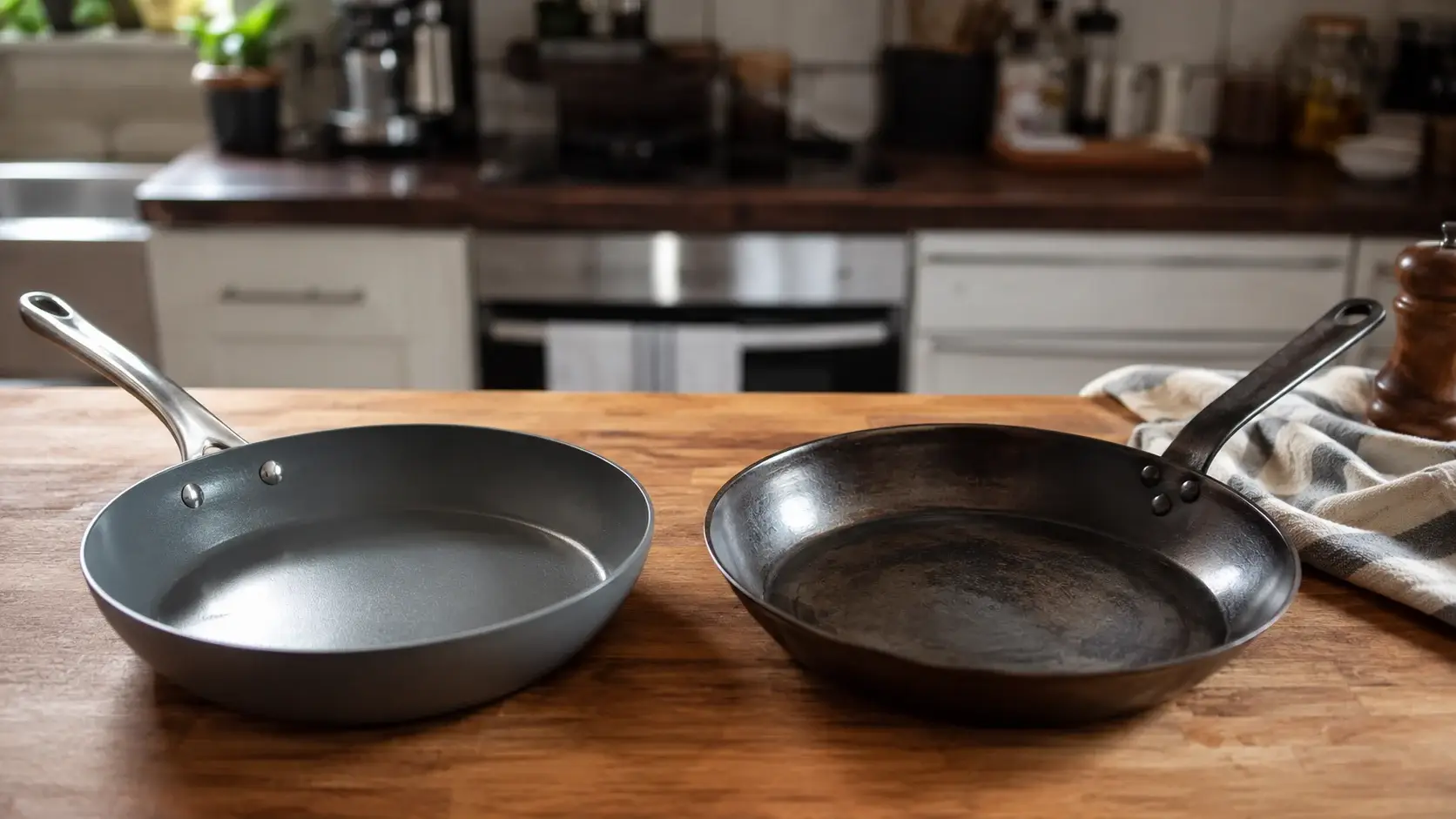
When you strip away Teflon, you are left with two major categories of cookware: ceramic-coated pans and naturally non-stick metals like cast iron or carbon steel.
They work in completely different ways, and each has a specific set of downsides that brands hide in the fine print.
Ceramic Coatings (The Sol-Gel Method)
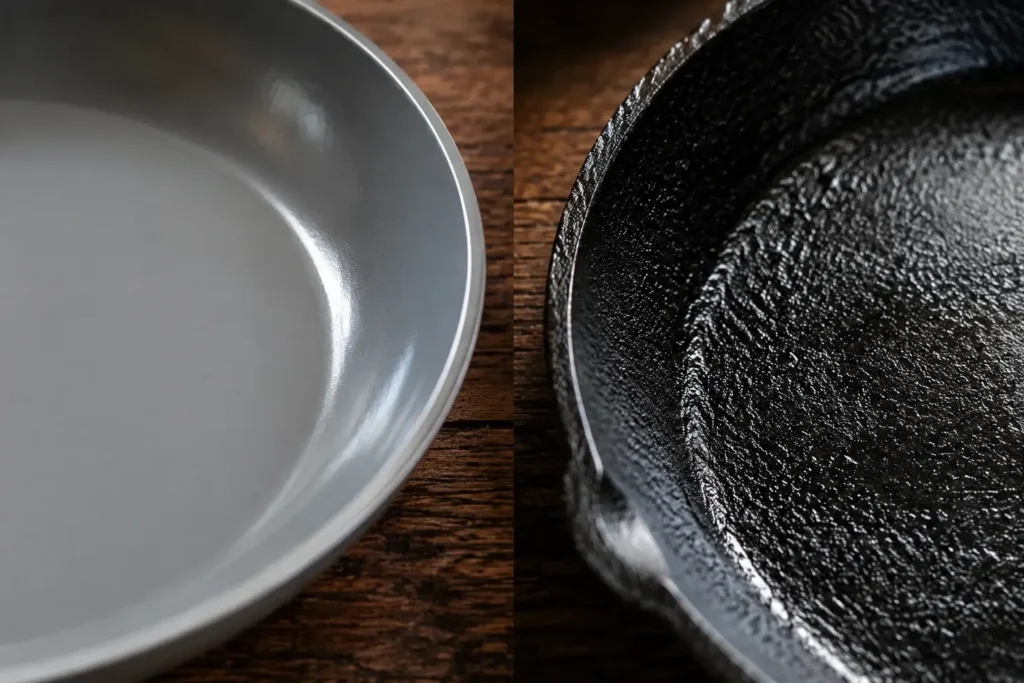
Ceramic pans do not actually have clay or pottery on them. They are made of metal (usually aluminum) sprayed with a liquid mixture made from silica (sand). This is called the “sol-gel” process.
The liquid is baked onto the pan at high heat, turning into a thin, glassy layer of shiny silicon. Because it is made of sand, it contains zero PFAS, zero heavy metals, and zero Teflon. You can heat a ceramic pan to 800°F and it will never release toxic flu fumes.
Natural Metal Surfaces
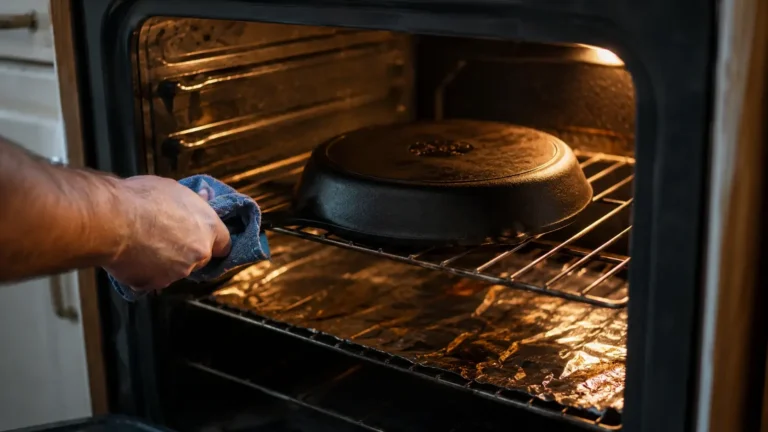
Cast iron and carbon steel do not use synthetic coatings at all. Instead, you create a slick surface yourself through a process called polymerization.
When you rub a very thin layer of cooking oil onto raw iron or steel and heat it up, the liquid fat transforms into a hard, plastic-like protective layer that bonds to the metal.

This is what we call “seasoning.” My mom had an old, beat-up iron pot she used for Sunday roast, and nothing ever stuck to it because decades of cooking fat had built up a flawless natural shield.
| Cookware Type | Maximum Safe Heat | Lifespan of Non-Stick Layer | Dishwasher Safe? | Price Range |
| Ceramic Coated | 650°F to 800°F | 6 to 24 Months | Absolutely Not | $30 – $120 |
| Carbon Steel | 800°F+ (Indestructible) | Lifetime (Self-Renewing) | Absolutely Not | $40 – $90 |
| Cast Iron | 800°F+ (Indestructible) | Lifetime (Self-Renewing) | Absolutely Not | $20 – $70 |
The One-Star Review Truth About Ceramic Pans
If you go to Amazon and look up the top-selling ceramic pans, you will see thousands of five-star reviews written the exact week people opened the box. The pans are gorgeous, the eggs slide around like hockey pucks on ice, and everyone is happy.
But if you click on the one-star reviews and filter by “received after 6 months,” a completely different story emerges.
Micro-Fractures and Thermal Shock
The number one complaint about ceramic pans is: “It worked great for three months, but now everything sticks and the middle is brown.”
This is not a manufacturing mistake; it is basic physics. Ceramic glass is very brittle. Every time you heat a pan, the aluminum base expands quickly. The ceramic layer expands at a different rate. Over time, this constant expanding and contracting creates millions of microscopic cracks in the glassy surface.
If you take a hot ceramic pan and drop it into a sink of cool water to rinse it, the sudden temperature drop causes thermal shock. Those micro-cracks instantly split wide open. Food particles get trapped inside the cracks, and the non-stick magic vanishes forever.
The Baked-On Oil Trap
The second common failure mode involves cooking fats. Standard non-stick sprays (like aerosol cans) contain a chemical propellant called lecithin. Under heat, lecithin undergoes a permanent chemical change and glues itself to the microscopic pores of the ceramic glass.
Even if you use regular olive oil or butter, if the heat gets too high, the oil carbonizes. It turns into a microscopic layer of varnish that you cannot scrub off without destroying the slick finish underneath. Once that oil burns into the pores, your pan is functionally dead.
The Best Ceramic Options (If You Handle with Care)
If you live in an apartment, hate heavy gear, and want a simple pan for low-heat eggs, ceramic is still a viable option. But you have to buy the ones built to handle stress, and you must treat them gently.
GreenPan Valencia Pro Ceramic Fry Pan
GreenPan was one of the earliest brands to push ceramic technology. Their Valencia line is built with a hard-anodized aluminum base, which means the metal is treated to be extra tough and warp-resistant.
- Why it is worth considering: The coating is reinforced with microscopic diamonds. Diamonds conduct heat incredibly fast and add structural strength to the glassy layer, making it slightly harder to scratch than cheap grocery store brands.

- Who it suits best: This pan is ideal for the beginner cook who wants a lightweight, everyday egg pan and has the patience to hand-wash it every single time.
Caraway Ceramic Frying Pan
This is the heavy, stunning pan that Paige keeps sending me. It has a thick aluminum core and a stainless steel base plate, which makes it feel sturdy and gives it excellent weight distribution.
- Why it is worth considering: Caraway uses a very thick application of their mineral-based coating. Because it is thicker, it resists minor abrasions slightly better than thin coatings. It also holds heat beautifully, meaning you do not have to crank your stove burner to get your food hot.
- Who it suits best: It suits home cooks who value design but are disciplined enough to use low heat settings and silicone spatulas exclusively.
The Real Best Alternatives: Cast Iron and Carbon Steel
If you are tired of throwing away a ceramic pan every two years, you need to look at natural materials. They take a tiny bit of work to maintain, but they are the true long-term answer to finding the best non-stick pans without Teflon coating.
Lodge 10.25-Inch Cast Iron Skillet
I use my 10-inch Lodge skillet almost every single day. It costs less than a couple of delivery pizzas, and it is completely indestructible.
- Why it is worth considering: It comes pre-seasoned from the factory with pure vegetable oil. Cast iron has immense thermal mass, meaning once it gets hot, it stays hot. It is perfect for getting a deep, crusty sear on a steak or a pork chop. If you want to master the basics of keeping this surface slick, the official Lodge Cast Iron care and seasoning guide provides clear, step-by-step instructions on rebuilding your pan’s natural barrier [opens in new tab].
- Who it suits best: Anyone who wants a pan that will last for decades and does not mind lifting a heavy piece of metal.
Oxo Outdoor Carbon Steel Frying Pan
Think of carbon steel as the hybrid child of cast iron and a slick non-stick pan. It is made of the same basic material as cast iron, but it is stamped into shape rather than poured into a mold.
- Why it is worth considering: It is significantly lighter than cast iron, and the sides are sloped, making it easy to toss vegetables or flip eggs with a flick of your wrist. It develops the same natural oil-polymerized non-stick coating over time.

- To ensure you are handling your food safely while using these traditional metals, the USDA’s guidelines on cooking temperatures and safe food preparation offer a great reference for matching pan heat to food safety [opens in new tab].
- Who it suits best: The cook who wants the bulletproof durability of iron but wants the nimble, lightweight feel of a classic chef’s pan.
If you are intimidated by the idea of seasoning a natural metal pan, you can watch this brilliant, step-by-step tutorial by [YOUTUBE EMBED: “How to Season and Maintain Carbon Steel Cookware” — America’s Test Kitchen — Why this video adds value here]. They demystify the entire process using science instead of guesswork.
How to Make a Teflon-Free Pan Last (The Cheat Sheet)
If you buy a ceramic pan, you have to read the instructions like a strict contract. To prevent your new purchase from ending up in the one-star review graveyard, follow these three non-negotiable rules:
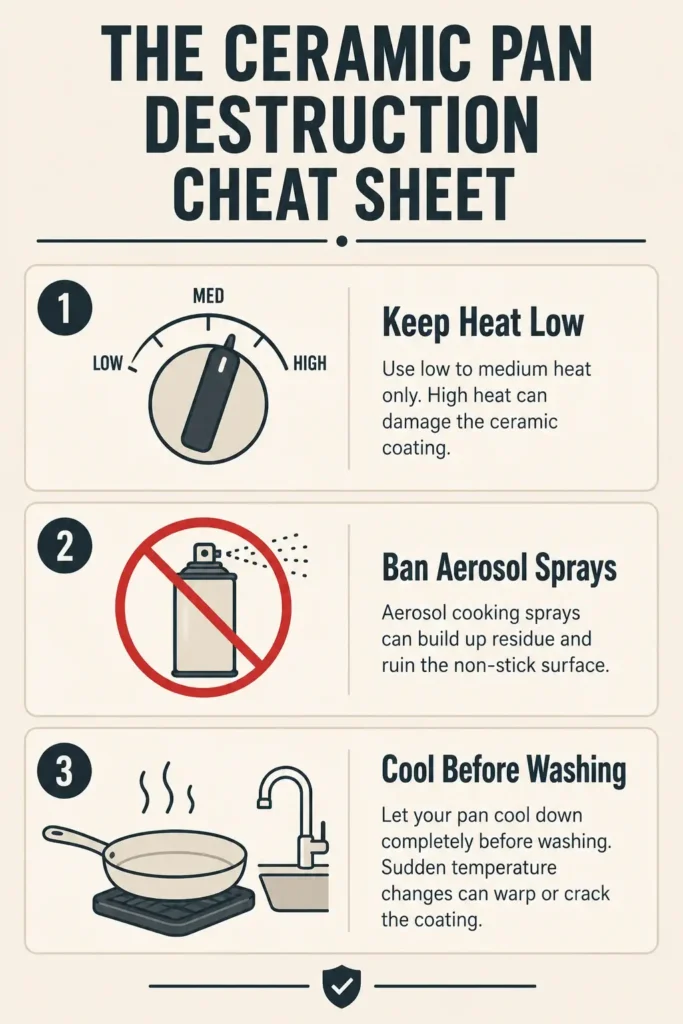
Rule 1: Ditch the High Heat
Ceramic pans conduct heat very efficiently. You almost never need to move your stove dial past medium. High heat scorches the oil into the microscopic pores of the glass, causing food to stick. Keep it low and slow.
Rule 2: Never Use Cooking Sprays
Avoid aerosol cans completely. The propellants leave a chemical film that permanently ruins the surface. Use a tiny bit of real butter, avocado oil, or olive oil instead.
Rule 3: The Cold Sink Ban
When you finish cooking, set the pan on a heat-safe mat and let it cool down completely before you touch it with water. Putting a hot pan under a cold tap is the fastest way to shatter the microscopic structure of your coating.
If you want to read a completely independent breakdown of how lab testers measure the lifespan of these coatings over thousands of cycles, you can look at the product testing methodologies hosted by Consumer Reports to see how cookware durability is evaluated under laboratory conditions [opens in new tab].
Frequently Asked Questions
Are ceramic non-stick pans completely safe for cooking?
Yes, ceramic coatings are completely non-toxic and safe for normal household cooking. Because they are made from silica minerals instead of synthetic chemicals, they do not contain any PTFE, PFOA, or other fluoropolymers. If you overheat a ceramic pan, it will not release any toxic gases or fumes, making it perfectly safe for homes with indoor pets or small children.
Why did my ceramic pan start sticking after a few months?
Your pan is likely sticking due to microscopic oil buildup or thermal shock. When cooking fats are heated too high, they turn into a fine carbonized film that glues itself into the tiny pores of the ceramic surface. Alternatively, if the pan was washed with cold water while still hot, the sudden shift in temperature causes micro-fractures in the glass layer, allowing food to catch and stick.
Can I use metal forks or spoons on a ceramic coating?
No, you should never use metal utensils on a ceramic pan. Ceramic glass is very hard but incredibly brittle. A metal fork or metal spatula can easily chip, scratch, or micro-fracture the thin non-stick layer. Always use soft tools made of silicone, wood, or heat-safe plastic to keep the surface smooth.
Is carbon steel better than a ceramic pan for beginners?
It depends on what you want to deal with. A ceramic pan is easier on day one because it requires zero preparation—you just wash it and start cooking. However, it will eventually wear out and need to be replaced. A carbon steel pan requires you to apply a manual oil seasoning before your first meal, and it cannot go in the dishwasher, but it will never wear out and can last for your entire life.
How do I properly wash a pan without Teflon coating?
You should always let the pan cool down to room temperature first. Then, wash it by hand using a soft sponge, warm water, and a mild dish soap. Never use abrasive scrubbing pads, steel wool, or harsh powder cleansers. Even if a brand claims their ceramic pan is dishwasher safe, the intense heat and harsh chemicals in dishwasher detergents will strip the slickness away in just a few cycles.
Do I need to use oil or butter in a ceramic frying pan?
Yes, you should always use a small amount of liquid cooking fat, like a teaspoon of butter or oil, to coat the surface before you turn on the heat. Running a ceramic pan completely dry can cause the surface temperature to spike instantly, which stresses the coating and reduces its overall lifespan.